I've been hosting an independent podcast for three years. In that time, I've interviewed 140 guests, read several hundred books and articles for episode research, and consumed somewhere around 2,000 hours of audio content in my niche. Almost none of that is accessible to me now. It lived in the research process and then disappeared after I recorded.
That's a knowledge problem specific to creators: you do deep research for a piece of content, use it once, and then it's gone. Not deleted — it might still be in a Google Doc somewhere — but functionally gone, because you'd have to re-read everything to get back to the insight.
I found sipsip's Mindverse while looking for a better way to manage guest research. What I discovered was something closer to a knowledge distillation workflow than a note-taking app.
The Research Graveyard Problem
Every podcast episode I produce involves 4-8 hours of research: background reading on the guest and their work, relevant books or papers, prior interviews they've given, industry context. I'd been keeping this in Google Docs — one document per episode, very organized, never read again.
Three years in, I had 140 research documents I'd invested thousands of hours in, and I couldn't easily surface any of it during new research. A guest from episode 23 had said something directly relevant to a conversation I was having for episode 118 — but I'd never make that connection because I wasn't re-reading three-year-old docs.
How Distillation Changed the Workflow
I started processing my research through sipsip's Transcriber and the distillation layer. The workflow:
For audio research (past episodes from other podcasts, expert interviews I listen to): I upload the audio file. Transcription is done in a few minutes. Distillation extracts the key claims, frameworks, and specific data points the speaker made. I get a structured output I can actually query — not a transcript I'll scroll past.
For article and book research: I use the browser extension to clip articles, or upload PDFs. Mindverse distills the key arguments and evidence, tagged by topic. After processing 200+ articles from my research archive, I can now query my knowledge base by concept and get grounded answers from actual sources.
For my own interview recordings: I record every guest interview (they know), and I upload the audio after we record. This was the most valuable part. Now all 140 guest conversations are distilled and searchable. When I'm preparing for a new guest and I remember "someone said something relevant to this topic two years ago," I can actually find it.
The Knowledge Compounds Now
After three months of processing my research archive into Mindverse, something shifted. I started seeing connections I'd never have found manually.
Two recent examples:
A guest mentioned a specific framework for thinking about creative consistency. Mindverse surfaced a conversation from 18 months earlier where a different guest had described the same phenomenon using completely different language. I used that connection in the follow-up conversation — it made the interview significantly more interesting because I could show the guest how their thinking connected to prior work in my knowledge base.
I was researching a topic for a solo episode and querying my knowledge base, and Mindverse surfaced a data point from a guest interview I'd almost forgotten — a specific statistic from their research that directly supported my main argument. I was able to cite it accurately, with attribution, because it was in my distilled knowledge base rather than buried in a doc I'd half-remember.
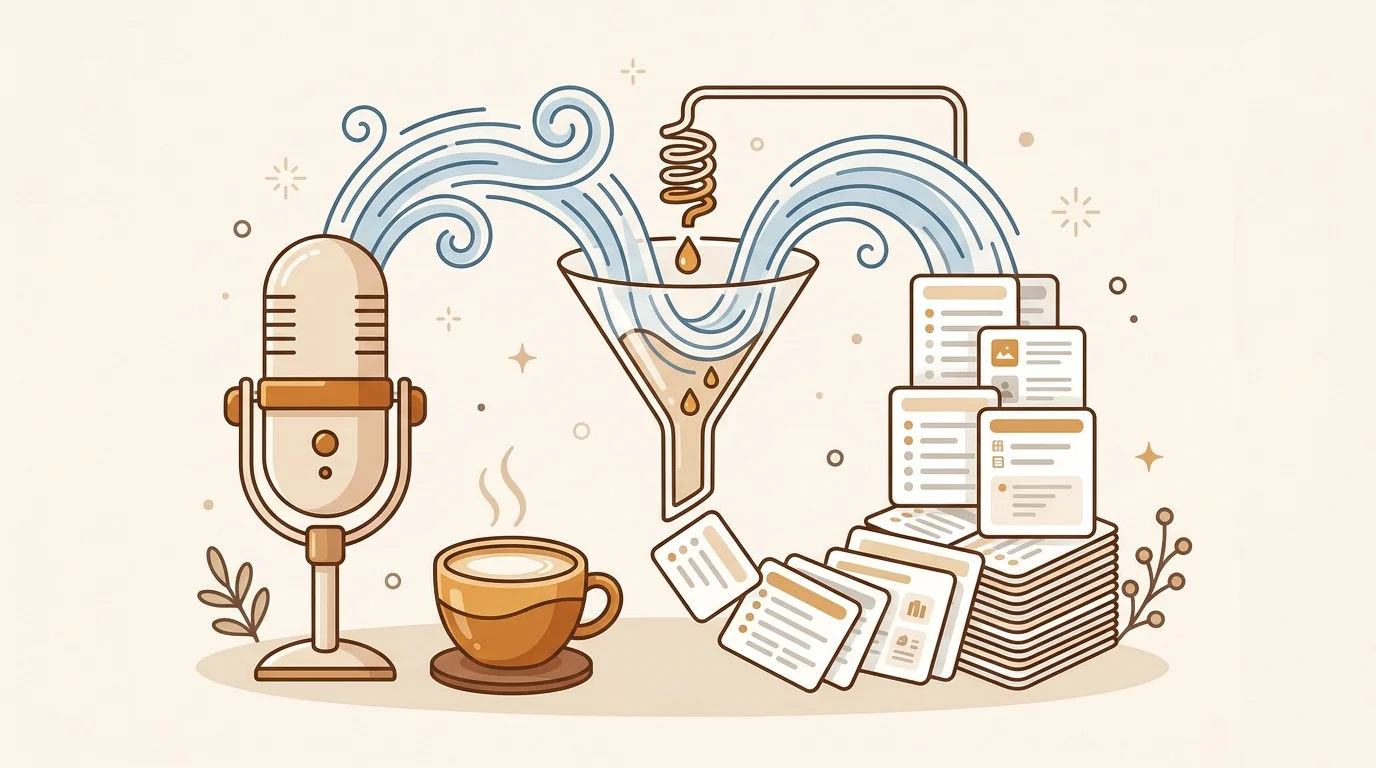
That's what knowledge distillation actually means in practice: your research compounds across projects rather than resetting with every episode.
My Setup
- All new research goes through Mindverse before I use it. Articles, audio, video — all processed through the distillation pipeline.
- Guest research goes in 1-2 weeks before the interview, so Mindverse can surface connections from my existing knowledge base during prep.
- After each interview, I upload the recording. Mindverse processes it and connects it to the relevant topics in my knowledge base.
- The Daily Brief handles my ongoing content consumption — I subscribe to about 15 podcast feeds and newsletters in my niche, and Mindverse synthesizes what's new each morning.
I spend significantly less time on research now — not because I'm doing less, but because I'm not re-covering ground I've already covered.
Related: What Is Knowledge Distillation? How AI Turns Information Overload Into Insight Complete Guide: Knowledge Management: The Complete Guide for 2026
Start building your research knowledge base at sipsip.ai — free to start, no credit card.
Frequently asked questions

Every episode requires hours of research I mostly forget. sipsip's knowledge distillation workflow changed that — my research now compounds instead of disappearing after recording.