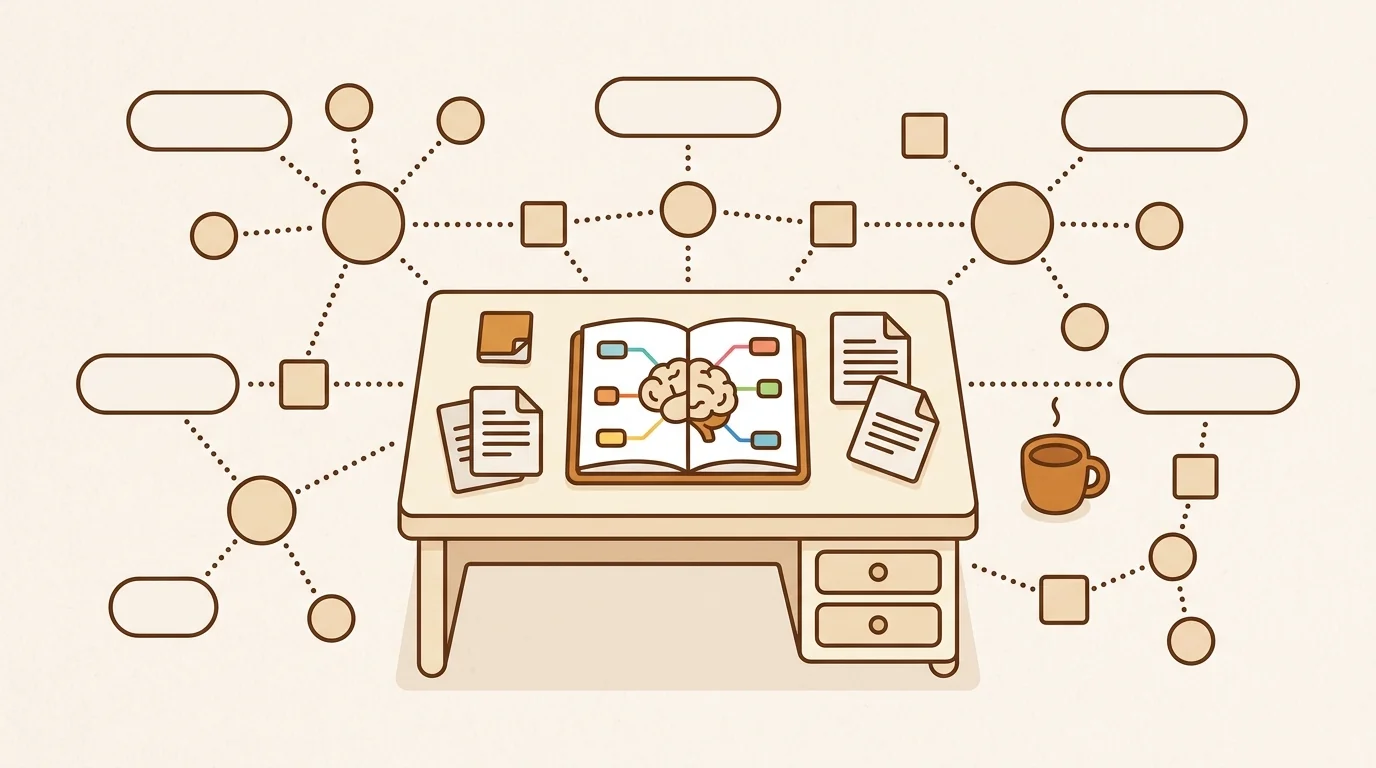
The standard advice for PhD students is to keep a research journal, use Zotero for citations, and take notes in whatever system you prefer. I did all of that for two years. At the end of two years, I had a Zotero library with 400+ papers, a research journal I rarely re-read, and a growing sense that I was failing to connect ideas across my literature in any systematic way.
I'm a PhD candidate in cognitive science, studying how people form and retain conceptual understanding. The irony of struggling with my own knowledge management wasn't lost on me.
The problem wasn't that I wasn't capturing. I was capturing plenty. The problem was that my capture system and my retrieval system were completely disconnected — and retrieval is where the value lives.
What Academic Knowledge Management Actually Requires
Research knowledge management is different from professional knowledge management in one key way: the time horizon. A product manager needs to remember what was decided last quarter. A researcher needs to synthesize ideas across a five-year literature, where the connections between papers published years apart are exactly what generate new insight.
That's hard to do manually. Zotero gives you a searchable bibliography, but it searches metadata (title, author, tags I've manually applied), not the content of the papers. My handwritten notes were indexed by my memory, which meant I could find things I specifically remembered but couldn't surface things I'd forgotten or hadn't consciously connected.
sipsip's Mindverse changed the structure of my knowledge base fundamentally, because it stores and retrieves processed ideas — not documents.
My Setup
Papers: I upload PDFs to Mindverse via the browser extension or direct upload. The distillation layer extracts the key claims, methodology summary, and main findings. I add a brief note about why I'm reading the paper (what question it addresses for my work). Mindverse processes both and connects the paper's claims to related work in my knowledge base.
After processing 180 papers from my core reading list, I have a knowledge base where I can query by concept — "find everything about spaced repetition and conceptual learning" — and get results grounded in actual paper claims, not just titles where those words appear.
Conference talks: I process every conference presentation I attend or watch recorded through sipsip's Transcriber. Academic talks often contain insights that don't appear in published papers — preliminary findings, methodological discussions, Q&A exchanges that expose the field's open questions. My conference knowledge used to be entirely in my notes. Now it's in a searchable, connected knowledge base.
Research interviews: My fieldwork involves interviews with research participants. All interviews (consented) are processed through Transcriber. The distillation extracts themes, specific quotations, and patterns across participants. I can query "what did participants say about [concept]?" and get structured answers rather than manually reviewing 60 interview transcripts.
Literature connections: This is where Mindverse earns its place. When I add a new paper, Mindverse surfaces related papers I've already processed — based on shared concepts, not just matching keywords. The connections it surfaces are often ones I wouldn't have thought to make manually, because they cross subdisciplinary boundaries that I don't always navigate consciously.
A Concrete Example
I was reviewing literature on metacognition for a chapter draft last month. I queried my knowledge base and got a result set that included:
- 8 papers I'd read and consciously filed under "metacognition"
- 4 papers I'd filed under "self-regulation" and "learning strategies" — related, but I wouldn't have searched there
- 2 conference talks I'd processed where metacognition came up as a side topic in Q&A, never in the main presentation
- 1 interview excerpt where a participant described a process that matched a key metacognitive pattern from the literature, in lay language
That last one — the interview excerpt matching a theoretical construct from the literature — is exactly the kind of connection that dissertation chapters are made of. I hadn't consciously made it. Mindverse found it.
What I'd Tell Other Researchers
The value of a research knowledge management system is not in the individual items you store. It's in the connections it enables across items you stored at different times, for different reasons, in different formats.
Zotero does not do this. A research journal does not do this. A folder full of annotated PDFs does not do this. A system that distills content into structured ideas and then actively connects those ideas across your full corpus — that does this.
Mindverse is the closest thing I've found to a knowledge management system built for how research actually works: nonlinear, cross-disciplinary, and dependent on connections you make months or years after the initial capture.
Related: What Is Knowledge Distillation? How AI Turns Information Overload Into Insight Complete Guide: Knowledge Management: The Complete Guide for 2026
Start your research knowledge base at sipsip.ai — free tier, no credit card, starts building connections immediately.
Frequently asked questions

Academic research produces enormous volumes of content to track. sipsip Mindverse became my knowledge management system — connecting literature, conference talks, and fieldwork into one searchable base.