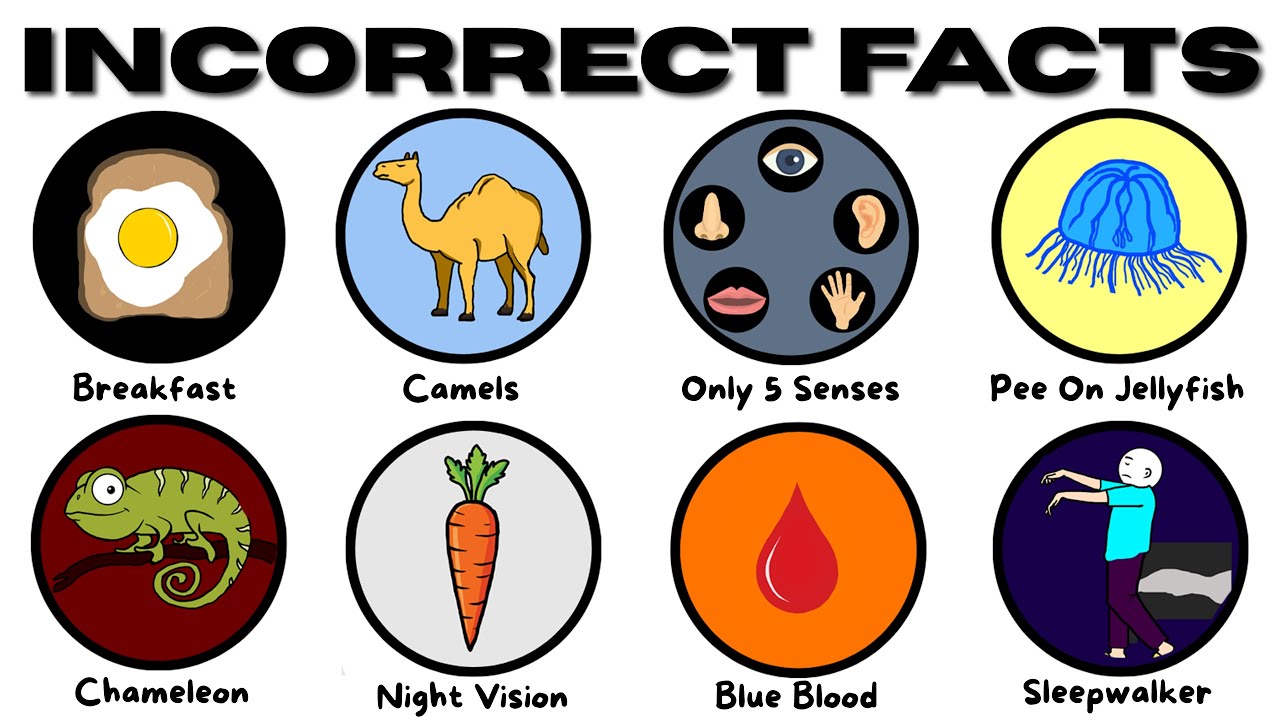
Many commonly held beliefs are actually incorrect, often stemming from marketing, ancient ideas, or even wartime propaganda. For instance, the notion that breakfast is the most important meal of the day originated from cereal companies in the late 1800s and early 1900s. Science shows that overall diet and lifestyle are more crucial than the timing of the first meal, and some people thrive on skipping breakfast entirely.
Another widespread misconception is that camels store water in their humps. In reality, these humps are filled with fat, serving as an energy reserve. Camels are incredibly efficient at water conservation, able to drink vast amounts and survive for weeks without more, but their humps are not water tanks.
The idea that humans possess only five senses dates back to Aristotle. Modern science identifies at least nine senses, including balance (vestibular sense), body awareness (proprioception), temperature sensing (thermoception), pain (nociception), and internal body signals (interoception).
Peeing on a jellyfish sting, a common trope in movies, is actually harmful. Urine can trigger remaining venom cells to release more toxins. The correct treatment involves rinsing with seawater and applying heat or vinegar.
Chameleons do not change color primarily for camouflage. Their color shifts are a form of communication and temperature regulation, influenced by their mood and environment, rather than an attempt to blend perfectly into their surroundings.
The belief that carrots provide night vision is a myth from World War II British propaganda. While carrots contain beta-carotene, essential for eye health, they do not grant supernatural night vision.
Human blood is never blue; it is always red, varying in shade based on oxygen levels. The blue appearance of veins is an optical illusion caused by how light interacts with skin and blood vessels.
Waking a sleepwalker is not dangerous, despite popular belief. While they might be confused or startled, it will not cause serious harm. The real danger lies in allowing a sleepwalker to wander unsupervised.
Lightning frequently strikes the same place multiple times, especially tall structures. The saying "lightning never strikes the same place twice" is a metaphor, not a scientific fact.
Sharks have an excellent sense of smell, but they cannot detect a single drop of blood from miles away. Their ability to detect blood is impressive but often exaggerated in popular culture.
The notion that humans swallow eight spiders a year while sleeping is a complete fabrication. Spiders avoid warm, vibrating environments like a sleeping person's mouth.
Finally, pirates rarely made people walk the plank. This dramatic form of execution is largely a literary and cinematic invention; real pirates typically disposed of victims more directly.
Totally Incorrect Facts Everyone Still Believes
Summary·translated·EverythingProfessor
Shared by Wendy
Comments
Sign in to leave a comment.
No comments yet. Be the first to share your thoughts!