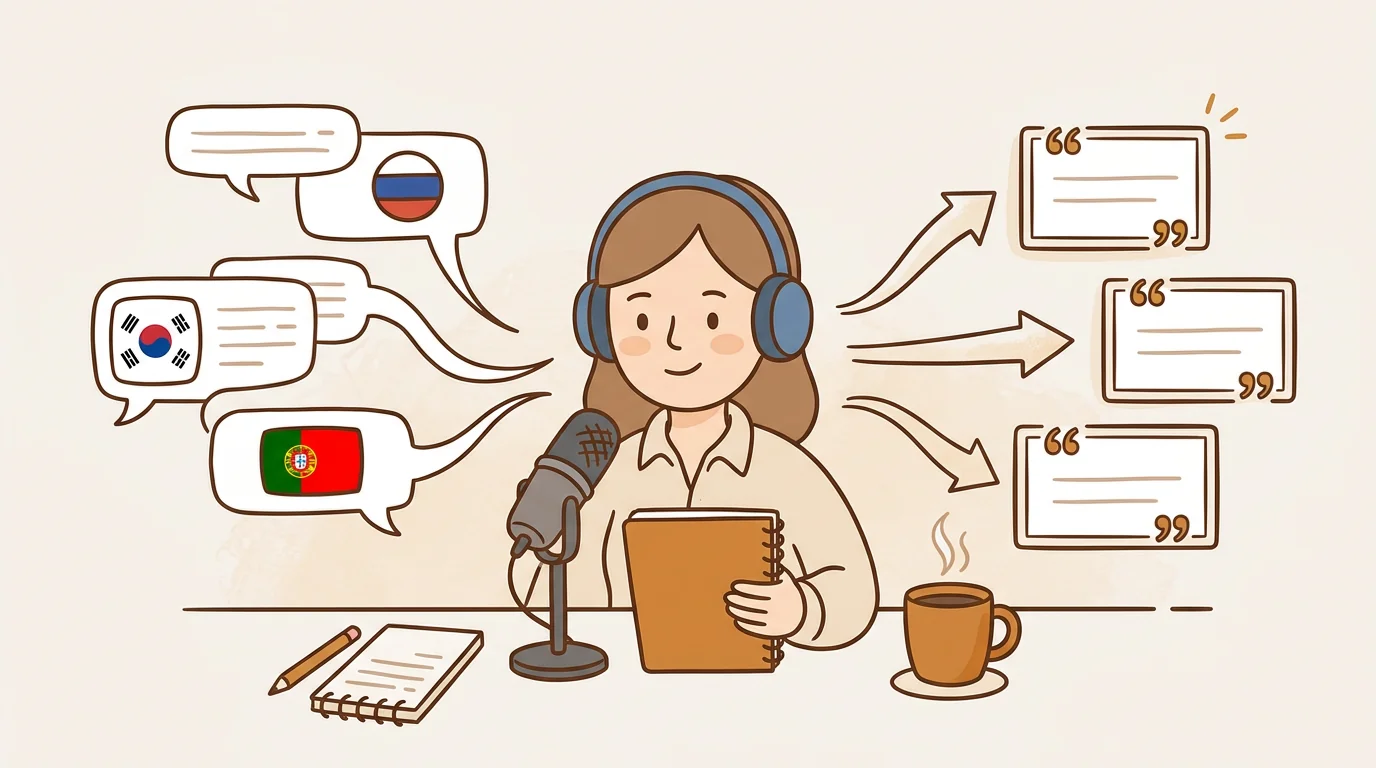
The best primary sources for a story about Korean startup funding dynamics are Korean podcasts. The most direct accounts of what's happening in Brazilian agribusiness are on Portuguese-language YouTube channels. The most unfiltered perspective on European tech regulation comes from French and German journalists talking to each other — not translating for English-speaking audiences. These sources exist. Most journalists working in English never touch them.
The Problem With English-Only Journalism
I've been a freelance journalist for six years, covering technology, business, and international markets. Early in my career, I reported what was already reported in English — synthesizing existing coverage rather than going to primary sources. That works until you need a story that hasn't been told yet, or a perspective that hasn't been filtered through translation and editorial framing.
The sources with the least editorial processing — raw interviews, local business podcasts, YouTube explainers from practitioners in the field — are overwhelmingly in the language of the market being covered. By the time those sources are translated and distributed in English, the story is already a week old and the angle has been softened for international audiences.
How I Used to Handle This
My previous workflow for foreign-language audio sources:
- Find the podcast or video
- Try to run it through Google Translate's audio feature (which only works for live microphone input, not recorded content)
- Attempt to locate an auto-generated transcript, if any
- Run the transcript through translation, getting mangled output with no sentence context
- Give up and look for an English-language source instead
Honestly, step 5 happened most of the time.
The sipsip Workflow
Now: I paste the URL into sipsip's Distill page, select English as the output language, and wait about 60 seconds.
For YouTube URLs and podcast links, sipsip returns:
- Full English translation of the spoken content
- Translated summary
- Translated key points — the key claims, data points, and quotes
That last item is what changed my reporting. The key points extraction surfaces the quotable moments — the places where a guest says something specific and unambiguous that I'd want to quote or paraphrase. In a 90-minute Korean fintech podcast, there might be three or four moments worth including in a story. sipsip surfaces them without me having to parse 90 minutes of translated text.
A Real Example
I was working on a story about how regulatory pressure on Korean fintech companies was affecting their international expansion plans. Most English coverage was thin — press releases and broad summaries. I found a 40-minute podcast interview with a CFO from one of the affected companies, in Korean, with no English subtitles.
I pasted the URL into sipsip, selected English. In about 50 seconds, I had:
- A full English translation of the interview
- A summary capturing the regulatory timeline and the company's stated response
- Key points that included three specific quotes about the impact on their European expansion plans
Those quotes became the spine of the story. They were primary-source material that no English-language outlet had, because the source was only accessible in Korean.
What I Use It For Weekly
Foreign-language podcast research: Any time a story involves a market outside the English-speaking world, there are almost certainly podcast conversations in the local language that are more current and direct than English coverage. I start with sipsip to scan these efficiently.
YouTube interviews: Entrepreneurs, investors, and operators in non-English markets frequently do their most candid interviews with local YouTube hosts. The translated key points help me identify whether a video contains reportable material in under 2 minutes.
Conference talks: International tech and business conferences produce hours of content in local languages. Pasting the YouTube recording URL into sipsip is faster than finding whether a translated transcript exists.
One Limitation to Know
For uploaded audio and video files, sipsip returns summary and key points rather than a full verbatim translation. For YouTube URLs and podcast URLs, you get the full translation — which is what I use most. If I'm working from a recording someone sent me rather than a public URL, the summary + key points output is still usually enough to determine whether the content is worth pursuing further.
For quotes that I intend to publish, I still do my own verification — either having a native speaker confirm the translation or cross-checking against other sources. AI translation is not perfect, and accuracy on specific claims matters for published journalism.
The Bigger Picture
Foreign-language primary sources have always existed. What's changed is that the friction of accessing them has dropped significantly enough to make them practical. That's not just a workflow improvement — it changes what kind of journalism is possible without a large translation budget or in-country fixers.
sipsip's free tier is where I'd start. Paste a foreign-language YouTube video or podcast URL, select English, and see what comes back. If you cover any international beat, you'll immediately see the potential.
James Okafor is a freelance journalist and podcast reporter covering technology, business, and international markets.

As a freelance journalist, half the best sources for international stories are in languages I don't speak. sipsip gives me translated transcripts and key points from foreign-language podcasts in under a minute.