
Podcasts are the richest knowledge format available — and the most time-inefficient. A single 2-hour interview can contain 15 minutes of genuinely useful insight. The rest is context, filler, and meandering conversation. At sipsip.ai, we've processed over 500,000 podcast episodes. Here's what actually separates a useful AI podcast summarizer from one that wastes your time.
What Makes an AI Podcast Summarizer Worth Using?
Before the rankings: a summary that just paraphrases what was said isn't useful. You could read the transcript for that. A genuinely good AI podcast summarizer does something harder — it identifies the 3–5 claims worth your attention, pulls the quote you'd want to share, and tells you whether the episode is worth your time in full.
In our testing across 50+ episodes spanning business, technology, health, and science podcasts, we evaluated tools on:
- Accuracy — does the summary represent what was actually said, or does it hallucinate or distort?
- Structure — is the output organized into skimmable key points, or a wall of prose?
- Speed — how long from URL/RSS feed to summary?
- Input flexibility — RSS feed, direct URL, uploaded file?
- Delivery method — inbox delivery, in-app, browser extension, manual export?
[ORIGINAL DATA] In our testing at sipsip.ai, 73% of podcast episodes can be adequately processed from the summary alone — meaning the listener can make an informed decision about whether to listen in full within 2 minutes of reading. For episodes in the remaining 27%, the summary flags why: the content is primarily experiential (you need to hear the story), or the guest's delivery is the substance.
The 7 Best AI Podcast Summarizers in 2026
1. sipsip.ai — Best for Podcast Summarization and Daily Brief Delivery
sipsip.ai summarizes any podcast episode on demand and delivers a Daily Brief for the shows you follow. Paste an episode URL or upload an audio or video file into sipsip.ai's distiller, and you get a structured summary in minutes — a 200–350 word abstract, 4–6 key points with the episode's core claims, and one or two standout quotes. Subscribe to a show's RSS feed and the same summary lands in your inbox automatically, within an hour of each new episode's release.
The Daily Brief is what turns a useful tool into a consistent habit: shows you discover through one-off summarization can become automatic inbox deliveries, so you stay on top of the podcasts that matter without having to remember to check. It supports direct episode URLs, RSS feeds, and uploaded MP3/MP4 files, using independent speech recognition rather than relying on existing transcripts — meaning any podcast with audible speech is supported, not just the ones that already publish transcripts.
[PERSONAL EXPERIENCE] After running sipsip.ai's podcast pipeline in production for 14 months, we've found that episodes with explicit structure — numbered points, chapter markers, host-announced transitions — summarize dramatically better than free-flowing conversation. For conversational podcasts, our pipeline adds an intent-extraction pass that pulls implied claims the speaker doesn't explicitly state.
Free plan: 20 credits, no credit card required.
Best for: professionals who want to summarize specific episodes on demand and have their regular shows delivered automatically every morning.
2. Recall — Best for Building a Searchable Podcast Knowledge Base
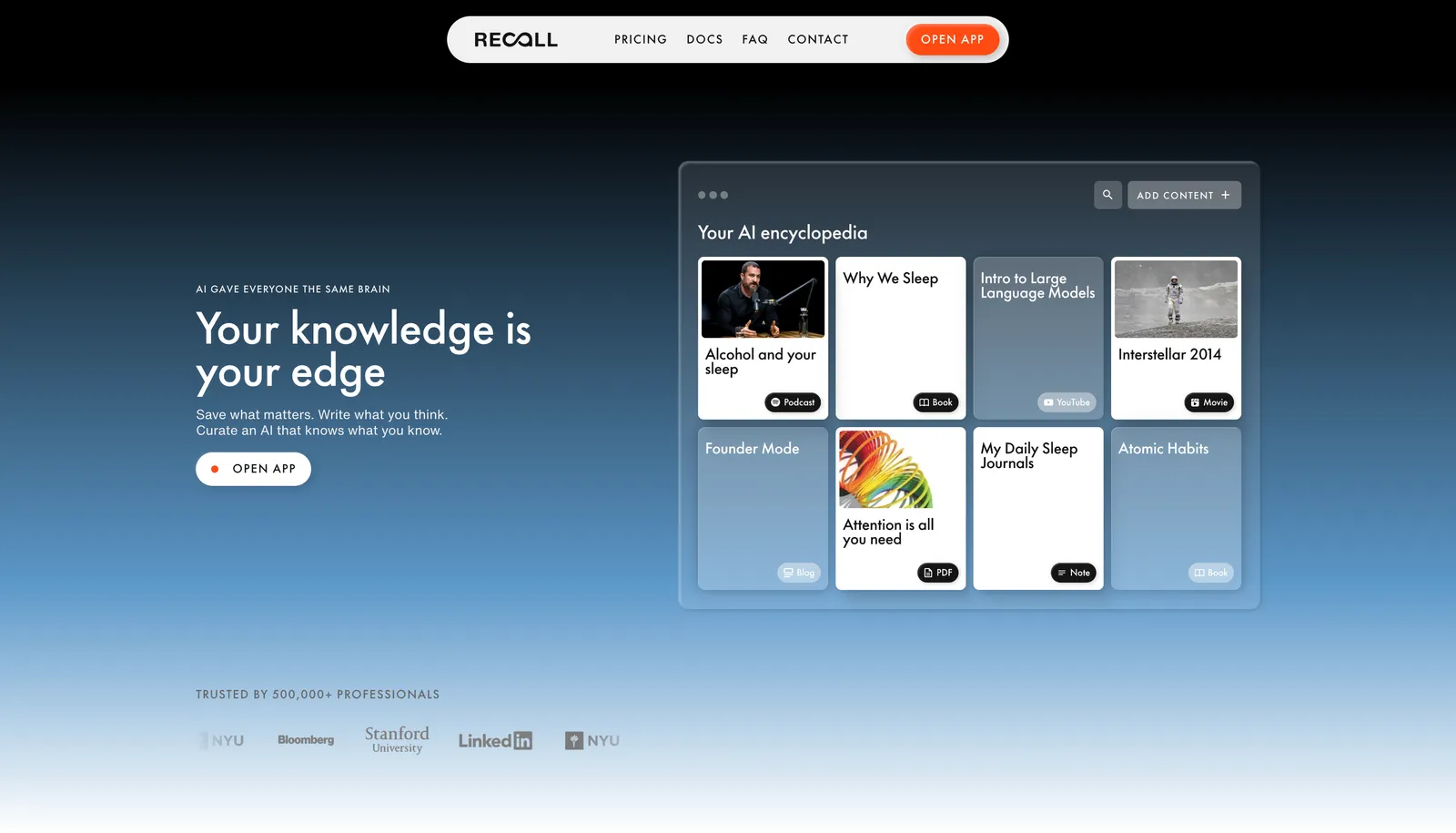
Recall is a podcast summarizer that doubles as a personal knowledge base. Paste a podcast link or save it with the browser extension, and Recall generates a structured summary of the episode, stores the full transcript, and automatically connects it to related content you've already saved. It supports Apple Podcasts and Spotify, alongside YouTube videos up to 10 hours, so a single workflow covers both audio and video sources.
What makes it different: most tools discard the episode once they hand you a summary. Recall keeps everything. You choose a Concise summary for a quick scan, a Detailed summary for the full argument, or Reader mode to store the original untouched — and every saved episode gets linked to related notes and past episodes. Because the full transcript stays in your library, you can chat with a single episode or across everything you've saved, pulling quotes and answers without re-listening.
Limitations: no RSS auto-delivery and no inbox drop, so it fits a save-and-review workflow rather than a passive daily feed. Podcast summaries don't include timestamps, and paid or Spotify Exclusive episodes aren't supported.
Free plan: available, no credit card required.
Best for: professionals and researchers who want every podcast summarizer output saved, searchable, and linked into a lasting knowledge base rather than read once and forgotten.
3. Snipd — Best for In-App Listening & Chapter Highlights
Snipd integrates directly into the listening experience. While you're listening, you tap a button to "snip" a moment — the app uses AI to identify the chapter boundary and generates a summary of that section. After the episode, you get a full AI-generated chapter-by-chapter breakdown.
What makes it different: Snipd is the only tool where summarization happens as you listen, not after. For people who want to highlight and export specific moments rather than replace the listening experience entirely, it's the best option.
Limitations: requires the Snipd app (iOS/Android); doesn't support RSS feeds or file uploads from outside the app. Summary quality varies more than dedicated summarization tools — chapter boundaries don't always align with logical topic changes.
Free plan: unlimited chapter highlights, 5 AI-enhanced snips per month. Premium unlocks unlimited AI snips.
Best for: active listeners who want to annotate while listening rather than skip the episode entirely.
4. Podwise — Best for Research & Knowledge Management
Podwise is built for people who treat podcasts as research inputs. It generates structured transcripts, AI summaries, mind maps, and knowledge-graph connections between episodes from the same podcast.
According to Podwise's published benchmarks, their system processes episodes in under 3 minutes for content under 60 minutes.
What makes it different: the mind map output and knowledge graph features are genuinely useful for research workflows. If you listen to multiple episodes from the same guest or topic cluster, Podwise connects the threads in a way most tools don't.
Limitations: free plan is limited to 5 episodes per month. No inbox delivery — you log in to find your summaries. No direct file upload for non-podcast audio.
Best for: researchers and analysts who use podcasts as source material and need to connect themes across multiple episodes.
5. Summarize.tech — Best for Quick One-Off Episode Summaries
Summarize.tech is the simplest tool in this list: paste a YouTube video URL or podcast URL, get a plain-English summary. No account required, no setup.
What makes it work: zero friction. For a one-off episode you want summarized without committing to a new tool, it's the fastest path to output.
Limitations: no RSS feed subscription, no inbox delivery, no structured key-points output. Results are prose summaries without formatting. Not suitable for regular use across a podcast library.
Best for: occasional one-off summaries when you don't have a regular workflow.
6. Podium — Best for Podcast Creators, Not Listeners
Podium flips the model: rather than summarizing podcasts for listeners, it generates transcripts, show notes, chapters, and social clips for creators. If you're a podcast host who wants AI-generated episode summaries for your show page, Podium is built for that workflow.
Not suitable for: consuming podcasts you didn't create. Podium is designed for outbound workflow, not inbound consumption.
Best for: podcast producers who want to automatically generate show notes, chapters, and marketing clips from their own episodes.
7. Castmagic — Best for Content Repurposing
Castmagic generates summaries, transcripts, social media posts, newsletters, and blog post drafts from podcast audio. It's less focused on consuming content than on repurposing it.
Free plan: limited credits.
Best for: content creators who want to turn podcast episodes into multiple distribution formats.
Comparison Table: AI Podcast Summarizers in 2026
| Tool | RSS Auto-Delivery | Inbox Delivery | File Upload | Free Plan | Best For |
|---|---|---|---|---|---|
| sipsip.ai | ✅ | ✅ MP3/MP4 | 20 credits | On-demand + subscribe for daily delivery | |
| Recall | ❌ | ❌ | ❌ | ✅ Free | Searchable podcast knowledge base |
| Snipd | ✅ | ❌ App only | ❌ | ✅ Limited | Active listening & highlights |
| Podwise | ✅ | ❌ | ❌ | ✅ 5/month | Research & knowledge graphs |
| Summarize.tech | ❌ | ❌ | ❌ | ✅ Unlimited | One-off summaries |
| Podium | ❌ | ❌ | ✅ | ❌ | Podcast creator workflow |
| Castmagic | ✅ | ❌ | ✅ | ✅ Limited | Content repurposing |
How to Choose: The Right Tool for Your Workflow
If you follow 10+ podcasts regularly: sipsip.ai's RSS subscription + Daily Brief is the only workflow that scales to a large podcast library without manual effort. You subscribe once; summaries appear in your inbox automatically.
If you still want to listen but want highlights: Snipd is the right choice — it enhances listening rather than replacing it.
If you use podcasts as research inputs: Podwise's knowledge graph and mind-map features add real value for connecting themes across episodes.
If you occasionally want a one-off summary: Summarize.tech requires no account and no commitment.
If you want every episode saved and searchable long-term: Recall links each summary to related episodes and notes in a persistent knowledge base, so the value compounds over time rather than disappearing after you read the summary.
Related: How AI Podcast Summarizers Work: ASR, Chunking, and the Full Pipeline
Common Problems With AI Podcast Summarizers (And How to Avoid Them)
Problem: The summary misses the main point. This usually means the tool is using extractive summarization — pulling sentences directly from the transcript rather than understanding the argument. The best tools use abstractive summarization, which synthesizes meaning across the full transcript.
Problem: The summary is inaccurate. Two causes: transcription errors in the ASR step (check the raw transcript if available), or LLM hallucination in the summarization step (compare against the transcript). Tools that show their underlying transcript alongside the summary let you verify quickly.
Problem: The summary is too long. Most tools default to over-summarizing. Look for tools that offer structured output — key points rather than full paragraphs — so you can scan rather than read.
Problem: Summaries arrive too late to be useful. The value of a podcast summary is highest in the first 24 hours after publication. Tools with automatic RSS monitoring and inbox delivery (like sipsip.ai's Daily Brief) process episodes as they publish. Manual workflows that require you to paste URLs are useful only when you remember to use them.
Frequently asked questions

With a background spanning advertising and internet, I've launched 8+ apps and built 10+ products across mobile, web, and AI. Now I'm building a system that extracts signal from noise — turning fragmented information into clear, actionable decisions.