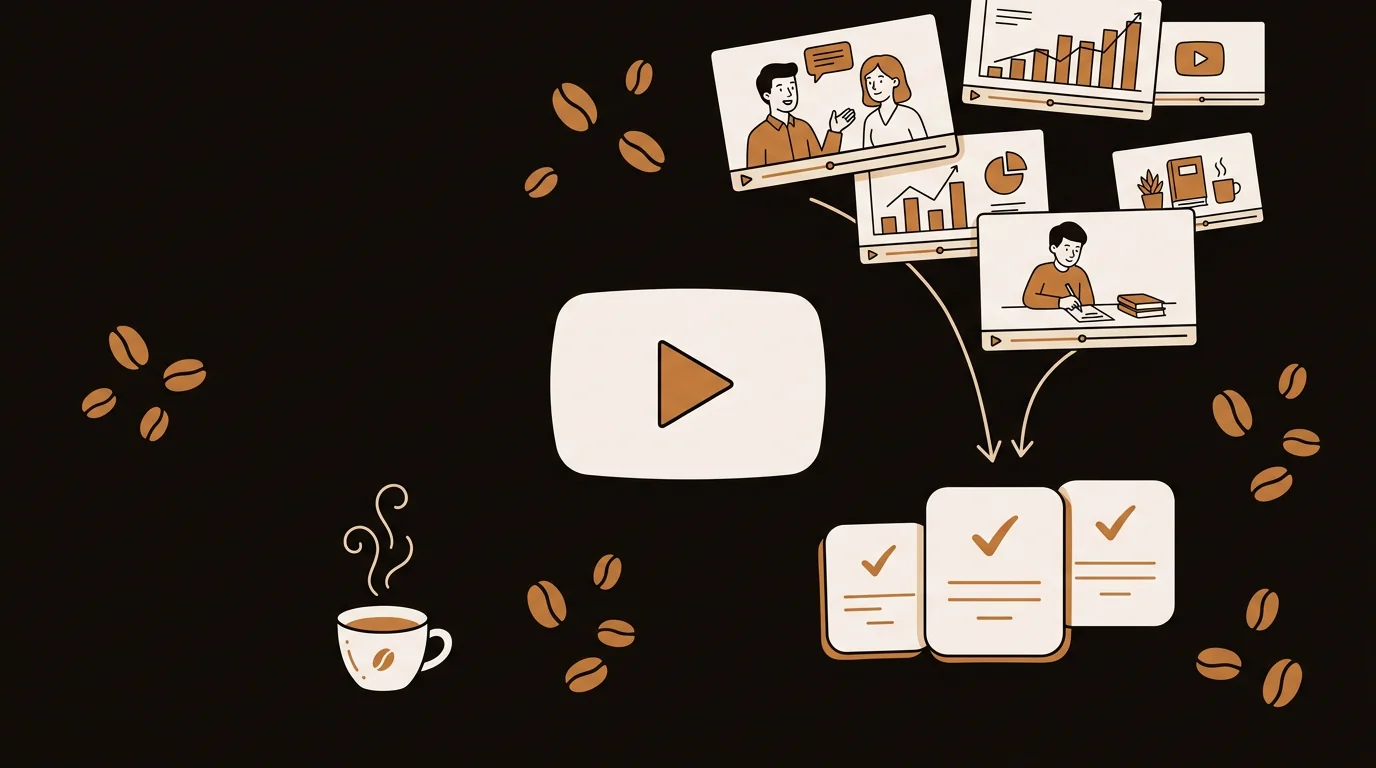
At sipsip.ai, we process thousands of YouTube videos every month. We've run our pipeline on everything from 8-minute tutorials to 4-hour conference talks. Here's an honest ranking of the YouTube video summarizers that actually work in 2026 — plus the ones that produce output you can't trust.
What Makes a YouTube Video Summarizer Worth Using?
A YouTube summary that just restates the video title isn't a summary — it's a caption. A genuinely useful AI video summarizer identifies the specific claims, examples, and data points that make the video worth watching. It tells you what the speaker argued, not what they talked about.
In our testing across 40+ videos spanning tech tutorials, business talks, academic lectures, and long-form interviews, we evaluated tools on:
- Accuracy — does the summary match what was actually said?
- Depth — does it capture specific claims and data, or just topics?
- Speed — seconds from URL to summary?
- Format — skimmable key points vs. wall of prose?
- Automation — can it run without manual input every time?
[ORIGINAL DATA] In our internal testing at sipsip.ai, videos with manual human-edited transcripts produced summaries with 31% fewer factual errors than videos summarized using YouTube's auto-generated captions alone. The gap is largest for technical content with jargon, proper nouns, and numbers — exactly the content where accuracy matters most.
The 7 Best YouTube Video Summarizers in 2026
1. sipsip.ai — Best for Automated Daily Consumption
sipsip.ai's Daily Brief is the only YouTube summarizer in this list built around channel subscription rather than one-off URL paste. Subscribe to any YouTube channel's RSS feed, and new videos land as structured summaries in your inbox automatically — typically within an hour of upload.
What the summary includes: a 200–350 word abstract, 4–6 key claims with the video's core arguments, one or two standout quotes, and a "worth full watch" recommendation based on content density.
What makes it different from other tools: most YouTube summarizers require you to go find the URL and paste it. sipsip.ai monitors the channel and sends the summary to you. For professionals following 5–15 YouTube channels regularly, this is the only workflow that doesn't break down when you're busy.
[PERSONAL EXPERIENCE] We built sipsip.ai's video pipeline after noticing that our own team was manually watching YouTube videos we'd already mentally catalogued as "probably useful." The inbox-delivery model changed behavior: instead of bookmarking videos to watch later (and often never watching them), team members now skim the summary in their morning email and decide immediately whether the video earns 30 minutes of their day.
Input flexibility: YouTube channel URL (automated subscription), direct video URL, or uploaded MP4 file. Free plan: 20 credits, no credit card required. Paid plans: see sipsip.ai pricing. Best for: professionals who follow multiple YouTube channels and want summaries without manual effort.
2. Eightify — Best for In-Browser Instant Summaries
Eightify is a Chrome extension that adds a summary panel directly inside YouTube's interface. Open any video, click the Eightify button, and get a chapter-by-chapter breakdown without leaving the page.
What makes it work: zero friction for one-off videos. If you're already watching YouTube and want to skim a video before committing, Eightify is the fastest path to an answer.
According to Eightify's own product page, their system has processed over 10 million videos since launch — making it one of the most widely adopted YouTube summarizer tools available.
Limitations: no inbox delivery, no channel subscription, no automation. Every summary requires you to be on YouTube and actively click. Summary quality varies across video types — interview-heavy content summarizes less cleanly than structured educational videos.
Free plan: limited summaries per day. Premium unlocks unlimited. Best for: casual users who want quick summaries while browsing YouTube.
3. NoteGPT — Best Free No-Signup Option
NoteGPT lets you paste a YouTube URL and get a summary with no account required. It also offers transcript extraction, AI chat against the video content, and flashcard generation from the transcript.
What makes it stand out in the free tier: no account, no credit card, no friction. For students or occasional users who want a one-off summary, it's the lowest-barrier option available.
[UNIQUE INSIGHT] NoteGPT's chat-against-transcript feature is genuinely underrated for research workflows. Instead of reading a full transcript, you can ask "what evidence did the speaker give for this claim?" and get a specific, cited answer. Most YouTube summarizers only give you a static summary — NoteGPT lets you interrogate the content.
Limitations: free tier has daily usage limits. The summary format is less structured than dedicated tools — output is typically a few paragraphs rather than organized key points.
Free plan: yes, no signup required for basic summaries. Best for: students and researchers who want to extract specific information from individual videos without signing up.
4. Summarize.tech — Best for Quick One-Offs
Summarize.tech is the simplest tool in this list: paste a YouTube URL, get a plain-English summary. No account, no extension, no setup.
What it does well: it just works. The output is a coherent paragraph-form summary that captures the main points of most standard-length videos (under 30 minutes).
Limitations: no structured key-point output, no chapter breakdown, no automation. For videos over 45 minutes, summary quality drops noticeably. Not suitable for regular use across a channel library.
Free plan: unlimited one-off summaries. Best for: quick one-off summaries when you don't have a regular workflow.
5. Glasp — Best for Research & Note-Taking Integration
Glasp is a social highlighter that added YouTube summarization. While watching, you can highlight and annotate transcript sections, then export your notes to Notion, Obsidian, or a personal knowledge base.
What makes it different: the social layer. Glasp lets you see how other users highlighted the same video — useful for quickly identifying which sections other researchers found most valuable.
Limitations: requires a browser extension and an account. The social features can be noise if you just want a clean summary. Summary quality is adequate but not best-in-class.
Free plan: available with usage limits. Best for: researchers who want to integrate YouTube summaries into a personal knowledge management system.
6. Whisper + NotebookLM — Best for Technical Users
For users comfortable with AI tooling: OpenAI's Whisper for independent transcription (bypassing YouTube's auto-captions entirely), piped into Google's NotebookLM for summarization and Q&A.
Why this combination works: Whisper's transcription is more accurate than YouTube's auto-captions for technical content, and NotebookLM is unusually good at identifying the central argument in a piece of content — not just the surface topics.
Limitations: significant technical setup required. No automation, no inbox delivery, no one-click workflow. Each video requires manual processing.
Cost: Whisper API usage is low-cost at $0.006 per minute; NotebookLM is free for individual use. Best for: technical users who need maximum accuracy for specialized content.
7. Kome — Best Chrome Extension Alternative to Eightify
Kome is a Chrome extension similar to Eightify — it adds a summary panel inside YouTube's interface. The main differentiator is its output format: Kome generates cleaner bullet-point summaries compared to Eightify's chapter-by-chapter breakdown, which some users prefer for skimming.
Limitations: the same as Eightify — no automation, no channel subscription, requires manual click per video. Free tier limits apply.
Best for: users who prefer Eightify's concept but want a different output format.
Comparison Table: YouTube Video Summarizers in 2026
| Tool | Channel Subscription | Inbox Delivery | No Signup | Free Plan | Best For |
|---|---|---|---|---|---|
| sipsip.ai | ✅ | ❌ | 20 credits | Automated daily workflow | |
| Eightify | ❌ | ❌ | ❌ | ✅ Limited | In-browser browsing |
| NoteGPT | ❌ | ❌ | ✅ | ✅ | Students, research |
| Summarize.tech | ❌ | ❌ | ✅ | ✅ Unlimited | One-off summaries |
| Glasp | ❌ | ❌ | ❌ | ✅ | Knowledge management |
| Whisper+NotebookLM | ❌ | ❌ | ✅ API | ✅ Limited | Technical pipelines |
| Kome | ❌ | ❌ | ❌ | ✅ Limited | In-browser browsing |
How to Choose: The Right Tool for Your Use Case
If you follow YouTube channels for professional learning: sipsip.ai's channel subscription workflow is the only option that scales. You subscribe once; summaries appear in your inbox without manual effort.
If you want to skim a video before watching it: Eightify or Kome — both live inside YouTube's interface with zero workflow change.
If you're a student extracting research from specific videos: NoteGPT's chat-against-transcript feature adds real value beyond static summaries.
If you want zero friction for occasional use: Summarize.tech requires no account, no extension, no commitment.
Related: 7 Best AI Podcast Summarizers in 2026 (Tested & Ranked)
Common Problems With YouTube Summarizers (And How to Avoid Them)
Problem: The summary is inaccurate. Two main causes: YouTube's auto-captions have high error rates for technical vocabulary and proper nouns; and LLM hallucination can introduce claims the speaker never made. Tools that expose the underlying transcript (like NoteGPT) let you verify quickly. For critical accuracy, use a tool that independently transcribes from audio rather than relying on auto-captions.
Problem: Long videos get poor summaries. Videos over 90 minutes often exceed LLM context windows. Tools that chunk the transcript into segments and summarize each chunk before synthesizing a final summary preserve more detail. If you're summarizing 3-hour conference talks, test each tool's handling of long content before committing.
Problem: The summary misses the key insight. This usually signals extractive summarization — the tool pulled sentences from the transcript rather than understanding the argument. The best tools use abstractive summarization: synthesizing meaning across the full transcript rather than copying the most common phrases.
Problem: You forget to use the tool. Manual tools (paste URL → get summary) only work when you remember to use them. For regular YouTube consumption, automated channel subscription is the only workflow that doesn't break down.
Frequently asked questions

With a background spanning advertising and internet, I've launched 8+ apps and built 10+ products across mobile, web, and AI. Now I'm building a system that extracts signal from noise — turning fragmented information into clear, actionable decisions.