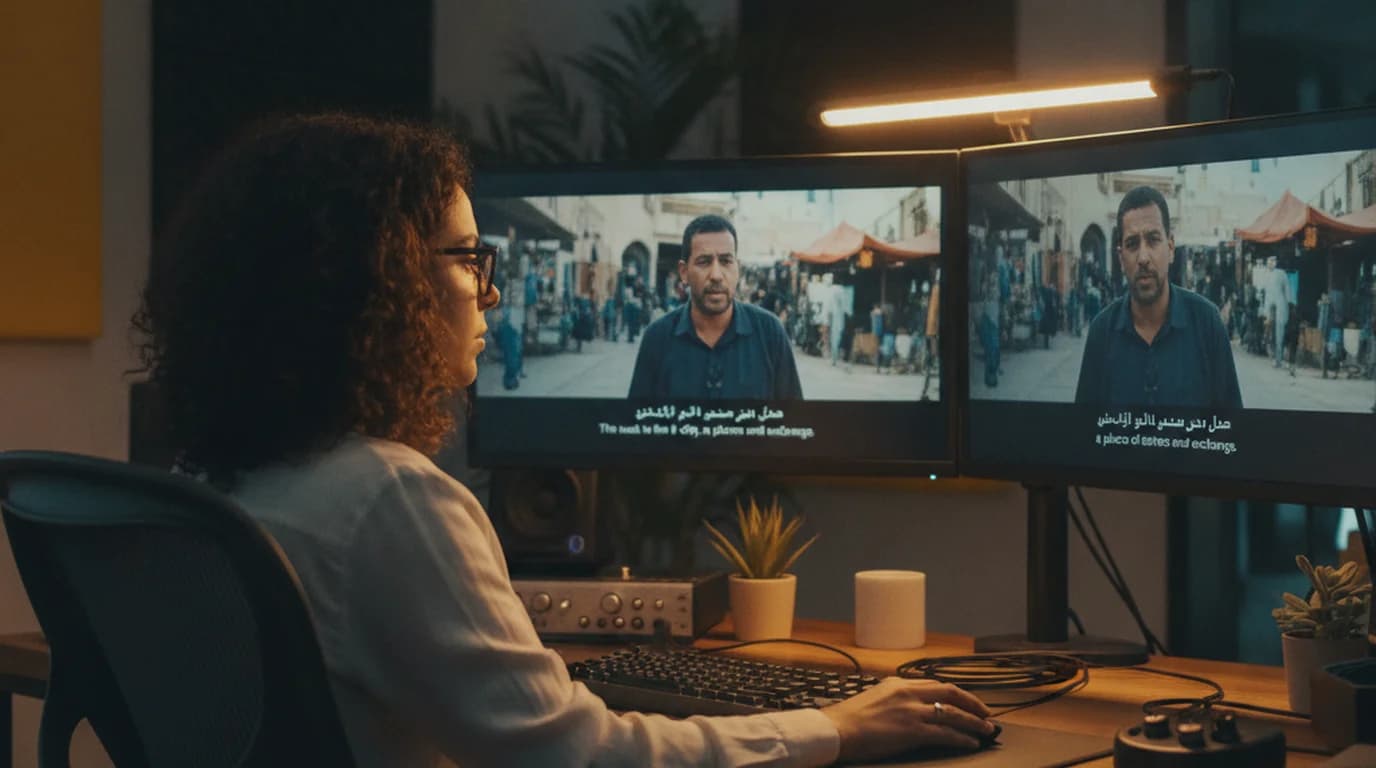
Running interview studies with Turkish-speaking participants is one of the more workflow-intensive parts of multilingual cognitive science research. When I started my dissertation fieldwork involving Turkish university students, I quickly learned that the standard approach — record in Turkish, manually transcribe, then translate — was going to eat weeks of time I didn't have.
Translating Turkish to English isn't just a language task. It's a structural problem. Turkish is agglutinative, which means meaning is packed into single words through stacked suffixes in a way English simply doesn't do. What comes out of an automated translation can sound correct while quietly losing precision — and in academic contexts, that precision is the whole point.
To translate Turkish to English: for text, use DeepL — it handles Turkish morphology better than Google Translate for formal or longer content. For Turkish audio and video, upload to sipsip.ai, transcribe with Turkish selected as the source language, then paste the transcript into DeepL. That two-step approach gives you better accuracy than any end-to-end audio translation tool currently available.
Why Turkish Is Structurally Different from Most Languages
Before choosing a translation tool, it helps to understand what makes Turkish uniquely difficult for automated systems.
Turkish is an agglutinative language: it builds meaning by stacking suffixes onto a root word. A single Turkish word can express what English needs five or six words to say. The word gidebilecektim ("I was going to be able to go") is one word in Turkish. That kind of morphological compression is standard, not exceptional.
Three structural features drive most translation errors:
Verb-final word order (SOV). Turkish uses subject-object-verb order. English uses subject-verb-object. For a machine translation system, this isn't just reordering — it means the verb that unlocks the meaning of the entire sentence comes last. Translation models have to process the full Turkish sentence before outputting anything in English, which is fundamentally different from how most Indo-European language pairs work.
Vowel harmony. Turkish suffixes change their vowels to match the dominant vowel in the root word. This creates predictable patterns for native speakers but adds morphological complexity that translation models must fully internalize to produce accurate output.
No grammatical gender, but extensive case system. Turkish has six grammatical cases conveyed through suffixes. Losing or misreading a single suffix changes the grammatical role of a noun in ways that can make a sentence mean the opposite of the original.
A 2024 PeerJ study on Turkish-English neural machine translation found that Turkish's morphological complexity makes it one of the more challenging language pairs for standard NMT architectures, with morphological analysis quality directly predicting translation accuracy. This is why tool selection matters more for Turkish than it does for, say, French or Spanish.
According to Ethnologue, Turkish has approximately 88 million speakers worldwide — primarily in Turkey, with significant populations in Germany (around 1.5 million speakers), Bulgaria, and diaspora communities across Europe and North America. Academic researchers working in migration studies, EU policy, oral history, and Turkic linguistics regularly encounter Turkish-language source material.
Best Tools to Translate Turkish Text to English
For written Turkish, two tools are worth evaluating seriously.
DeepL produces better English output from Turkish than Google Translate, particularly for longer or more formal content. Its neural translation architecture handles Turkish's SOV word order and complex suffix chains more cleanly. The output reads more naturally — fewer awkward phrasings that technically translate the words but miss the intended meaning. DeepL's free tier handles up to 500,000 characters per month, which covers substantial text translation volume.
In independent comparisons, DeepL consistently outperforms Google Translate on Turkish-English translation for content longer than a paragraph, with the gap widening on technical, academic, and formal register text. For informal short text — street signs, social media captions, brief messages — both tools perform similarly.
Google Translate remains useful for quick informal text, and it handles Turkish better than many less-commonly-supported languages. For academic content, interview excerpts, or anything being used in published research, DeepL is the better starting point.
Tool selection guide:
- Short informal Turkish text, social media, signs: Google Translate
- Formal documents, academic excerpts, longer articles: DeepL
- Audio and video recordings: transcribe first (see next section)
How to Translate Turkish Audio and Video to English
Standard translation tools don't process audio or video files. For Turkish recordings — interview data, focus group sessions, fieldwork audio, conference presentations, Turkish YouTube content — the workflow that works is transcribe first, then translate.
Step 1: Upload to sipsip.ai and select Turkish
Upload your audio or video file to sipsip.ai's audio transcriber. Select Turkish as the source language. For video files, use the video transcriber — it handles the same process and returns a time-stamped transcript you can use for citation.
For Turkish YouTube videos, paste the video URL directly into sipsip.ai. You don't need to download the file first.
A 45-minute Turkish interview recording typically takes 4–5 minutes to transcribe. The output is a full text transcript with timestamps and speaker labels where multiple speakers are present.
Step 2: Review proper nouns and academic terminology
Turkish proper nouns are the most frequent source of transcription errors — particularly names that have multiple romanization conventions (Turkish ş and ğ appear in names differently depending on context), and academic or technical terminology from fields like law, medicine, or social science. Scan the transcript before translating.
Field-specific vocabulary: Turkish academic discourse uses vocabulary that may not appear frequently in general translation training data. Terms from sociology, linguistics, and cognitive science — the fields most likely to involve Turkish-speaking participant research — are worth checking against a bilingual glossary or Turkish-language academic database.
Step 3: Translate the transcript with DeepL
Paste the transcript into DeepL and select Turkish as the source language. DeepL handles transcript text well — the punctuation and sentence structure from the transcription help anchor the translation context.
One practical note from my own fieldwork: Turkish interview subjects often use discourse markers that don't translate cleanly — yani (roughly "I mean" or "that is to say"), işte (a filler with no direct English equivalent, roughly "well" or "you know"), şey (used as a placeholder, like "thing" or "um"). These will appear in your transcript and need contextual judgment during translation — DeepL handles yani well, less so işte and şey.
For a broader overview of translating video content, the how to translate YouTube video to English guide covers workflow considerations across multiple source languages.

How to Translate Turkish Documents to English
For Turkish PDFs, Word documents, and formatted files:
DeepL's document upload handles Turkish Word (.docx) and PDF files directly. It preserves formatting — table layouts, numbered lists, font sizing — which matters for academic papers, official Turkish government documents, and legal records. A 10-page Turkish document typically processes in 30–60 seconds.
Important limitation for Turkish PDFs: PDFs from Turkish government agencies, older academic publications, and print-digitized content are frequently image-based rather than text-layer PDFs. DeepL's document upload requires a text layer. For image-based Turkish PDFs, run OCR first.
Turkish OCR presents a specific challenge: the Turkish alphabet includes characters not found in standard Latin — ş, ğ, ı (dotless i), ö, ü, ç. OCR software that doesn't explicitly support Turkish will misread these characters, producing transcription errors before translation even starts. Adobe Acrobat Pro handles Turkish OCR reliably. Among free tools, online OCR services with explicit Turkish language support outperform generic tools on these characters.
After OCR, run the text through a spell-check calibrated for Turkish — errors introduced by OCR compound during translation and are harder to catch after the fact.
Turkish-English Translation Challenges for Academic Researchers
Passive constructions and impersonal sentences. Turkish academic writing uses passive and impersonal constructions extensively — more so than equivalent English academic prose. Machine translation often renders these as active sentences with an implied subject, which can slightly shift the meaning. In qualitative research where attribution matters (did the participant say it, or is this a general claim?), review passive-to-active conversions in your translated transcripts.
Politeness levels and address forms. Turkish has a formal second-person (siz) versus informal (sen) distinction. This distinction disappears in most English translations, which default to "you" regardless. For interview data where the register of address is analytically relevant — research on power dynamics, institutional communication, inter-generational speech — make a note of this before the translation step.
Negation position. Turkish negation is expressed through a suffix on the verb, which comes at the end of the sentence. In long sentences, a negation that transforms the meaning of the entire clause can be easy to miss in Turkish but immediately visible in English. When DeepL or any translation tool handles a long Turkish sentence, check that negations have been correctly identified and rendered.
Code-switching in contemporary Turkish text. Urban Turkish speech — particularly from younger speakers and in social media, startup, and academic contexts — mixes English loanwords heavily into Turkish sentences. Words like meeting, deadline, feedback, update are used in Turkish sentences with Turkish morphology attached (feedbacki aldım — "I got the feedback"). Translation tools handle this variably; Google Translate tends to leave English loanwords in the output, which is usually correct, while DeepL sometimes over-translates them back to Turkish equivalents that the speaker didn't use.
For researchers specifically working with Turkish YouTube content, the best AI video translation tools 2026 comparison covers how current platforms handle Turkish subtitle generation specifically.
Translating English to Turkish
For the reverse direction, DeepL is again the stronger tool — it produces Turkish output that reads more naturally to native speakers, though neither DeepL nor Google Translate is suitable for formal publication in Turkish without native speaker review.
Key consideration for English-to-Turkish translation: the Turkish writing system is phonologically regular (each letter corresponds to one sound), and Turkish has strict rules about which suffixes can attach to which roots. Errors in English-to-Turkish translation often show up as unnatural suffix attachment rather than wrong vocabulary — which is harder for a non-native speaker to catch but obvious to a Turkish reader.
For participant materials in multilingual research (consent forms, survey instruments, interview guides), human translation with native-speaker review remains the appropriate standard. Machine translation can produce a working draft that significantly reduces the professional translator's time, but should not be the final product for participant-facing materials.
The translate audio guide covers the broader workflow for audio translation across multiple language pairs, including quality benchmarks for Turkish audio processing.
Frequently Asked Questions
How can I translate Turkish to English?
For Turkish text, use DeepL — it handles Turkish's agglutinative structure and long compound words better than Google Translate for formal or longer content. For Turkish audio or video, transcribe first with sipsip.ai, then paste the transcript into DeepL. This two-step method consistently outperforms end-to-end audio translation tools because speech recognition and text translation require different model architectures.
Is Turkish hard to translate to English?
Turkish is structurally challenging for automated translation because it's agglutinative — a single Turkish word can carry meaning that requires 5 to 6 English words to express. The verb-final sentence order (SOV in Turkish versus SVO in English) also forces complete reordering. DeepL handles this better than most tools, but academic and technical content still benefits from human review.
What is the best free Turkish to English translator?
For free Turkish to English text translation, DeepL's free tier handles up to 500,000 characters per month and produces more natural English output than Google Translate for Turkish. For audio and video, sipsip.ai offers free Turkish transcription without requiring an account for your first file.
How do I translate a Turkish video to English?
Upload the Turkish video to sipsip.ai, select Turkish as the source language, and transcribe. The tool returns a time-stamped transcript you can paste into DeepL for English translation. For Turkish YouTube videos, paste the URL directly into sipsip.ai — no download needed.
How do I translate Turkish audio recordings to English?
Upload your Turkish audio file to sipsip.ai's audio transcriber, select Turkish as the source language, and let it generate the transcript. The process takes roughly 4 to 5 minutes for a 45-minute recording. Then paste the transcript into DeepL to translate to English. This method is significantly more accurate than real-time audio translation tools for longer recordings.
Does Google Translate work well for Turkish?
Google Translate works for short, informal Turkish text — social media captions, labels, quick messages. For longer or more formal Turkish content, DeepL produces more natural English output. Turkish's complex morphology makes it particularly sensitive to translation engine quality, and the difference between DeepL and Google Translate is noticeable on content longer than a few sentences.
What makes Turkish translation different from other European languages?
Turkish belongs to the Turkic language family, not the Indo-European family that includes most European languages. Its agglutinative structure, vowel harmony, and verb-final sentence order have no equivalent in English. This is why tool selection matters more for Turkish than it does for French, German, or Spanish.
Can I translate Turkish documents to English automatically?
Yes. DeepL's document upload handles Turkish Word (.docx) and PDF files with a text layer directly. For scanned Turkish PDFs (image-based), run OCR with Turkish language support first, then translate. DeepL preserves formatting — tables, numbered lists, font sizing — which matters for academic papers and official documents.
Conclusion
For Turkish text: DeepL for anything longer than a sentence or in formal register; Google Translate for quick informal text. For Turkish audio and video recordings: sipsip.ai to transcribe with Turkish selected, then DeepL for the translation step. The two-step approach is slower by about 5 minutes per file but substantially more accurate than direct audio-to-English tools — especially for the agglutinative structures, discourse markers, and academic vocabulary that make Turkish translation non-trivial.
For academic researchers handling Turkish interview data, the transcript is also the research artifact — you need it anyway for qualitative analysis, ATLAS.ti or NVivo coding, and citation. Getting a clean Turkish transcript from sipsip.ai and then translating it is the same number of steps as any other workflow, with better output at the end.
Try sipsip.ai free — no account required for your first Turkish file.
Explore More
- How to Translate a YouTube Video to English — Step-by-step workflow for translating YouTube videos in any source language, including Turkish
- Best AI Video Translation Tools 2026 — Comparison of current AI translation platforms with Turkish-specific accuracy notes
- Translate Audio: Complete Guide — Full workflow for translating audio recordings across languages, with quality benchmarks
- Video Transcriber — Transcribe Turkish video files with timestamps and speaker labels
Amelia Scott is a PhD candidate in Cognitive Science whose dissertation research involves multilingual interview studies with Turkish, Arabic, and English-speaking participants. She uses sipsip.ai to transcribe Turkish and Arabic audio recordings before translation and qualitative analysis.
Frequently asked questions

I'm a PhD candidate in cognitive science. I work with multilingual research audio from interview studies conducted in Germany, Japan, and Brazil.