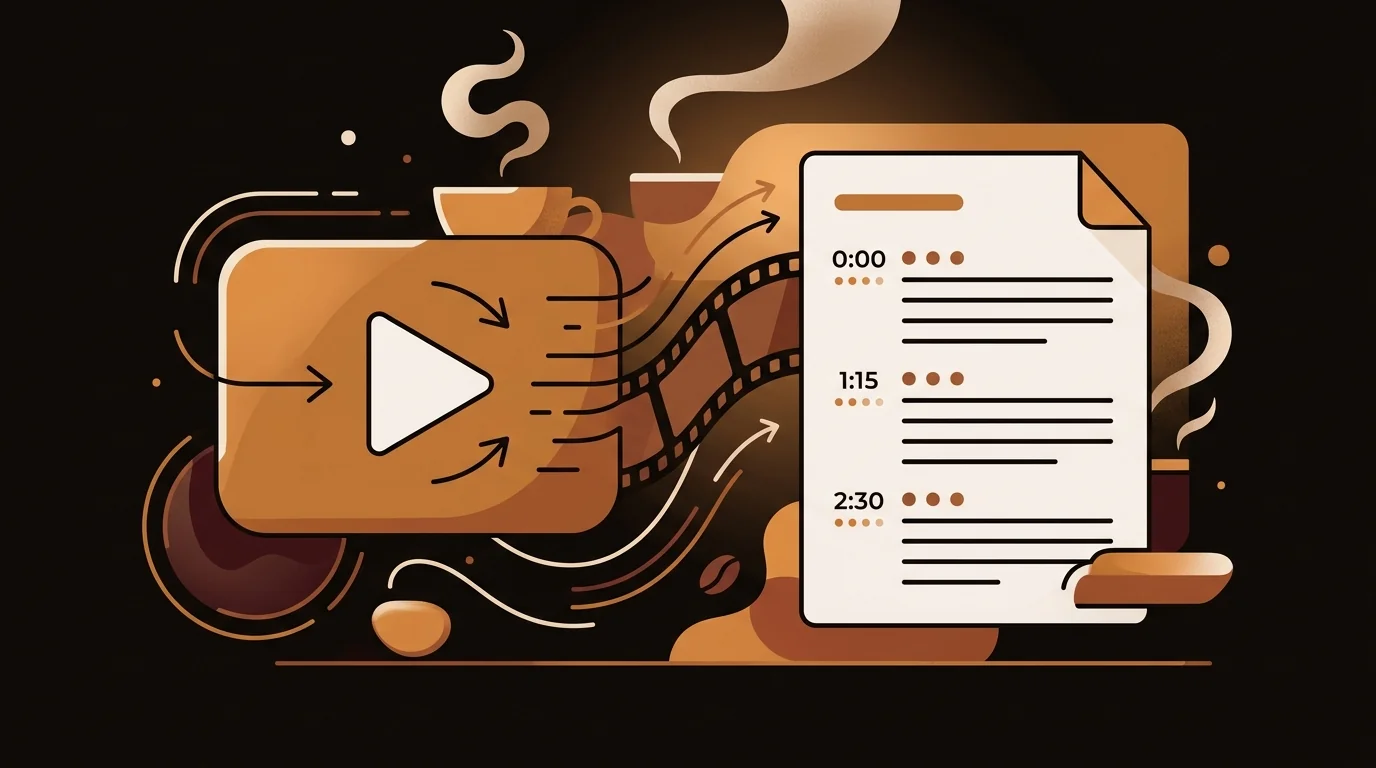
Video files contain spoken information that's invisible to search engines, inaccessible to screen readers, and impossible to skim. Converting video to text makes that content searchable, shareable, and usable in ways the original video never can be.
Free Video Transcription: What You Get Without Paying
Getting a video transcript without a paid subscription is genuinely possible in 2026. Here's what's free:
YouTube videos — sipsip.ai's YouTube Transcript tool requires no account and no payment. Paste a URL, get the full transcript in seconds. This covers any YouTube video that has captions enabled (which is most of them).
Uploaded video files — sipsip.ai's video transcriber also offers a free tier. Upload an MP4, MOV, MKV, or WebM file and receive the full transcript. Free accounts start with 20 transcription credits — enough for several full-length videos.
What "free" means in practice: The free tools give you the raw transcript. To get the AI summary, key points, and standout quote alongside the transcript, you need a free sipsip.ai account (no credit card required). The transcription itself is free either way.
How Video-to-Text Conversion Works
Video transcription is actually audio transcription with one extra step: the audio track is extracted from the video container before speech-to-text processing begins.
The pipeline looks like this:
Video file (MP4/MOV/MKV)
  → Extract audio track (FFmpeg)
  → Run Automatic Speech Recognition (Whisper / Deepgram)
  → Post-process: punctuation, casing, timestamps
  → Clean transcript text
For YouTube videos specifically, a faster path exists: YouTube generates caption data for most videos automatically, and this caption data can be extracted directly — no audio processing required. This is why YouTube transcript extraction takes 2–5 seconds instead of several minutes.
At sipsip.ai, we use the caption-first approach for YouTube and Whisper-based audio transcription for uploaded files.
Method 1: YouTube Videos → Free Transcript Tool (2–5 Seconds)
For any YouTube video with captions, the fastest path is sipsip.ai's free YouTube Transcript tool.
How to use it:
- Copy the YouTube video URL.
- Go to sipsip.ai/tools/youtube-transcript.
- Paste the URL and click Get Transcript.
- The full transcript appears in seconds — copy it, toggle timestamps on/off, or paste directly into your doc.
No account required for your first transcript. Supports 30+ languages.
What if the YouTube video has no captions? The free tool only works on videos where YouTube has generated captions. For videos without captions — or for non-YouTube videos — use Method 2 below.
Method 2: Zoom, Teams, and Loom Recordings
Meeting platform recordings are the most common source of video files that need transcribing. Each platform exports differently:
Zoom: Cloud recordings download as MP4 from your Zoom account (Recordings → Download). Local recordings save automatically to Documents/Zoom/. Upload the MP4 to sipsip.ai's video transcriber.
Microsoft Teams: Recordings appear in OneDrive or SharePoint after the meeting ends. Download the MP4 and upload it directly.
Loom: Open the video, click the three-dot menu, and select Download → MP4. The file is typically under 500MB for standard-length recordings.
Google Meet: Google Meet recordings save to Google Drive. Download the MP4 from Drive before uploading.
For meeting recordings specifically, speaker diarization — automatically labeling who said what — is useful. Sipsip's video transcriber outputs a clean timestamped transcript; to add speaker labels, note from the recording who spoke when and use the timestamps to attribute.
Method 3: Any Video File → Video Transcriber (MP4, MOV, MKV, and More)
For video files you have locally — screen recordings, downloaded videos, Zoom/Teams recordings, webinars, lecture captures — sipsip.ai's video transcriber handles the full audio extraction and transcription pipeline.
Supported formats: MP4, MOV, MKV, AVI, WebM
How to use it:
- Go to sipsip.ai/tools/video-transcriber.
- Upload your video file.
- The audio track is extracted automatically — you don't need to convert the file first.
- Whisper runs speech-to-text on the audio.
- The clean transcript appears, timestamped and ready to copy.
Processing time scales with video length. A 30-minute lecture takes about 3–5 minutes. A 90-minute webinar takes 7–10 minutes. You can close the tab and return — the result is saved in your history.
Method 4: Screen Recordings and Online Course Videos
Screen recordings (from Loom, QuickTime, OBS, or similar) are technically MP4 files and work exactly the same as Method 3 above. Upload the file and the audio track is transcribed.
For online course videos you can download (Udemy, Coursera with offline access, etc.), the same approach applies. For videos you can only watch but not download:
- Play the video through your speakers or headphones while recording your device's audio using a tool like Audacity (free, open-source)
- Export the recording as an MP3
- Upload the MP3 to sipsip.ai's audio transcriber
This is slower, but it works on any video you can play — including DRM-protected content for personal accessibility use.
What to Do With the Transcript
A video transcript is text — and text is significantly more useful than video for many downstream tasks:
| Goal | How to use the transcript |
|---|---|
| Study notes | Paste into Notion or Obsidian; add highlights |
| Content repurposing | Feed to an LLM and ask for a blog post draft |
| Accessibility | Add as closed captions or a companion document |
| SEO | Publish the transcript as a companion article |
| Search | Ctrl+F through hours of video content in seconds |
| Citation | Reference exact timestamps and quotes |
For lecture recordings and educational content, the transcript is the starting point. The full Sipsip Transcriber also generates an AI summary and key points — useful when you want the main takeaways without reading every word.
Video Transcription Accuracy: What to Expect
AI transcription accuracy for video depends almost entirely on the audio quality within the video, not the video format itself.
| Recording type | Typical accuracy | Main challenge |
|---|---|---|
| Lecture / single speaker, quiet room | 93–97% | Technical vocabulary |
| Interview / two-speaker conversation | 90–94% | Speaker overlap |
| Meeting recording (4+ speakers) | 82–90% | Crosstalk, varying mic distances |
| Field / outdoor recording | 72–84% | Background noise |
| Screen recording with voiceover | 94–97% | Usually ideal conditions |
The biggest accuracy factors:
- Microphone quality — a USB mic or headset dramatically outperforms a built-in laptop mic
- Background noise — AC hum, keyboard clicks, and room echo all hurt accuracy
- Speaker distance — the further from the mic, the worse the output
- Language — English, Spanish, French, German, Portuguese, and Japanese have the highest accuracy; less common languages have higher error rates
For most lecture, interview, and meeting recordings in reasonable conditions, the output is clean enough to use without significant manual correction.
Frequently asked questions

Across 8+ years, I've built full-stack and platform systems using TypeScript, Node, React, Java, AWS, and Azure, applying AI to practical problems and turning ambitious ideas into shipped products.