I'm an oral historian. My work involves recording extended interviews with elderly community members — people in their 70s, 80s, and older — across Japan, the Philippines, Taiwan, and the United States. These conversations, which run two to four hours each, become the primary source material for peer-reviewed research and community archive projects.
My transcription backlog had reached 62 hours of unprocessed recordings when I finally changed my process.
Why Oral History Transcription Is Different
Oral history is methodologically dependent on the complete transcript. Unlike journalism, where a few key quotes carry the story, historical analysis requires the full text — every hesitation, every digression, every moment where the narrative shifts. The transcript is the data.
Traditionally, professional transcription of oral history material runs at a 4:1 or 5:1 ratio: four to five hours of labor for every one hour of recorded speech. For non-English content, that ratio climbs. For elderly speakers with regional dialects or softer voice projection, it climbs further.
At 62 hours of unprocessed recordings, I was looking at approximately 280 hours of transcription work — nearly seven full working weeks. At that point, fieldwork had outpaced my ability to process it. I had recordings I'd made 14 months prior that hadn't been touched.
Why Previous Tools Didn't Work
I had tried general transcription services. The problems were consistent.
Language gaps. My interviews are conducted in Japanese, Tagalog, Mandarin, and English — sometimes within a single session, when bilingual subjects move naturally between languages. Services that claimed multi-language support often returned blank segments for non-English content or mixed-language exchanges, forcing me to re-transcribe those sections manually anyway.
Accuracy with elderly speakers. Speech recognition models trained on younger, native, studio-quality speakers perform significantly worse on elderly speakers with slower cadence, softer voice projection, and regional speech patterns. Output that required line-by-line correction didn't reduce my workload — it just changed what I was doing.
Data sensitivity. Oral history interviews contain personal and often painful disclosures. Uploading sensitive recordings to platforms with unclear data retention policies was not acceptable to my institution's IRB or to the subjects themselves.
The Two-Track Workflow I Use Now
After testing several options, I settled on an approach that matched tools to content type.
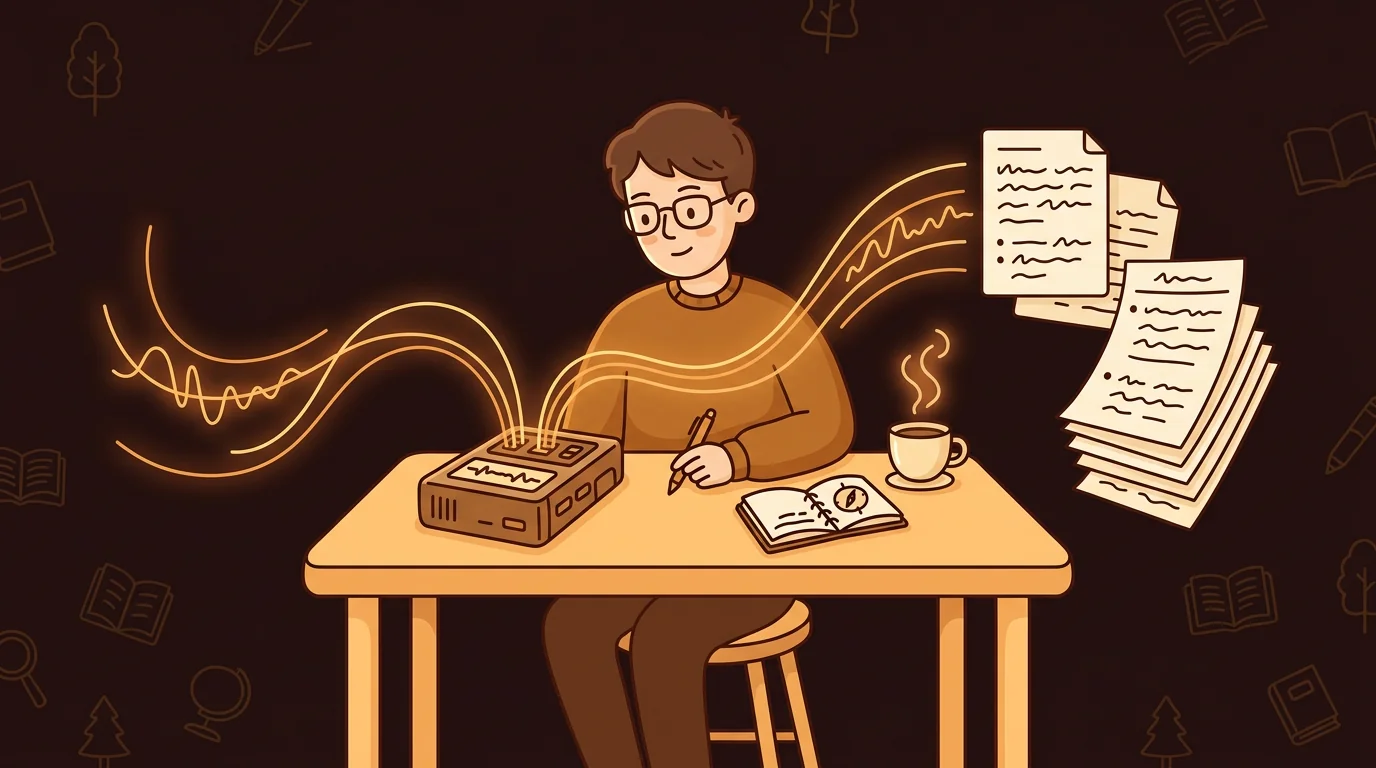
For English-language interviews: Sipsip's audio transcriber handles these directly. I upload the MP3 file, receive a clean, punctuated transcript within minutes, and review for accuracy corrections — which average two to five per 10 minutes of speech even for elderly speakers with regional accents. This is a fraction of the manual transcription time.
For non-English and mixed-language interviews: I use OpenAI Whisper running locally with the large-v3 model, which substantially outperforms cloud alternatives on Japanese, Tagalog, and Mandarin. Local processing also satisfies the IRB requirement that identifiable interview data not leave controlled institutional storage.
The combination cleared 62 hours of recordings in four days of normal working hours. Seven weeks of projected manual work became an editing and review task.
What Changes When You Have the Transcript
The immediate benefit is obvious: searchable, citable text instead of audio I have to re-listen to. But the downstream effects were more significant than I expected.
Cross-session analysis. With complete transcripts in a structured database, I can search across all 60+ interviews simultaneously. Finding six different subjects who mentioned a specific historical event — without remembering which tapes they appeared on — takes seconds. Before, it required re-listening to recordings I thought I remembered or keeping manual notes that were inevitably incomplete.
Collaborative research. My co-investigators, who are not fluent in all four interview languages, can now read translated-and-transcribed versions of interviews instead of relying on my summaries. Research that was previously bottlenecked on my availability became genuinely collaborative.
Archive compatibility. The community archives I contribute to work best with text files indexed by name, date, topic, and keyword. Audio archives are harder to curate and harder for other researchers to use. The transcript is the format the archive actually needs — and now I produce it as part of the normal workflow, not as a separate phase that kept getting deferred.
The Practical Details
I record on a portable field recorder, exporting to WAV at 44.1 kHz, then converting to MP3 before upload. Sipsip accepts both formats. File sizes for a two-hour interview in MP3 at standard quality run around 100–150 MB — within the upload limits I've worked with.
For interviews with multiple speakers — usually myself and one or two subjects — I don't rely on automated speaker identification. I do a light manual pass to mark speaker turns, which takes roughly 5–10 minutes per hour of audio. Faster than doing it from scratch, but not fully automated.
For interviews requiring factual precision — specific dates, place names, personal names — I do a verification pass against the audio. This takes 20–30 minutes per hour of content. The total time per hour of interview is now around 35–45 minutes of review, compared to 4+ hours of manual transcription from scratch.
The research moves at the speed of the conversations. The backlog that had been accumulating for 14 months no longer exists. New recordings are processed within 24 hours of returning from the field.
Sipsip's audio transcriber handles English-language field recordings with no setup required. For multilingual or sensitive research data that must stay on local infrastructure, the open-source Whisper model that powers Sipsip's backend is available for local deployment — covered in detail in our guide to open-source video transcribers.
Dr. Hiroshi Tanaka is an oral historian who records interviews with elderly community members across four countries and four languages. An audio transcriber turned a seven-week backlog into a four-day editing task.