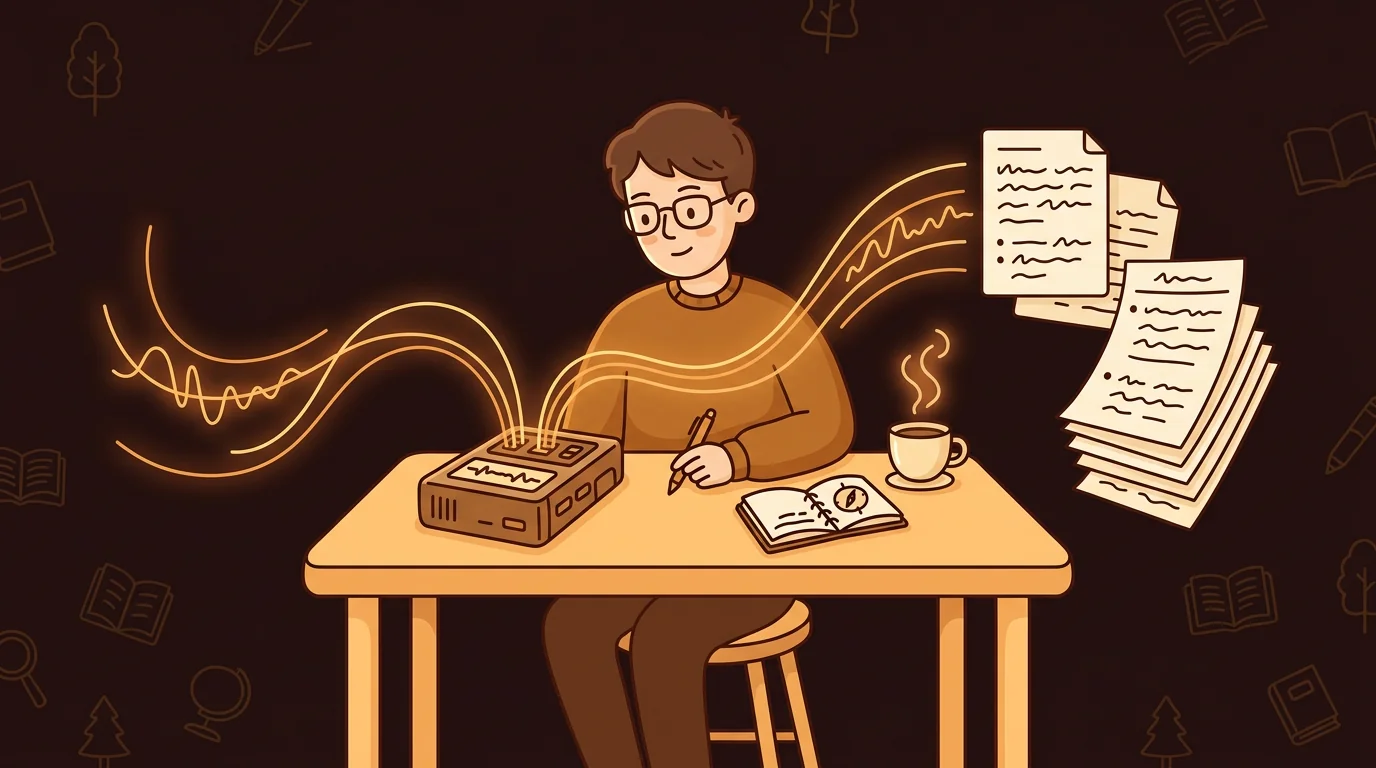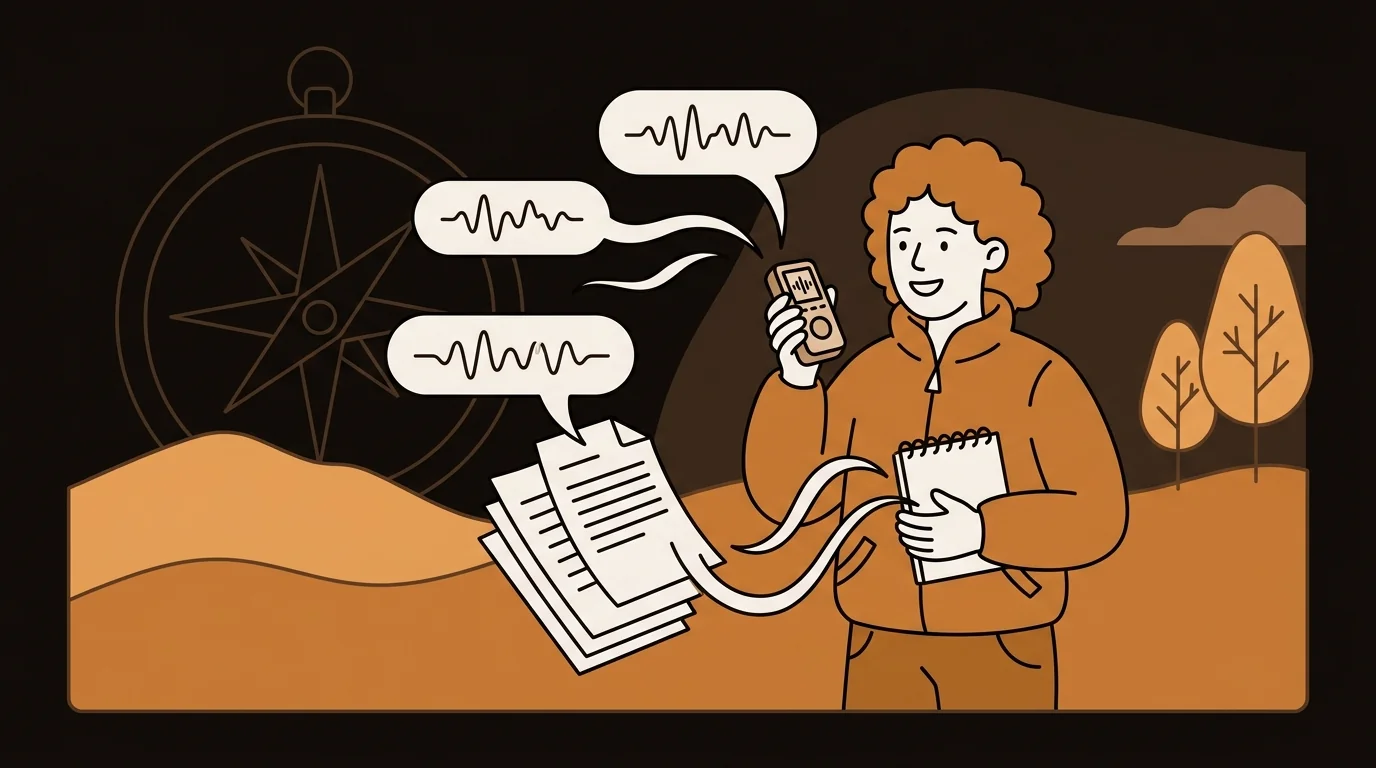
I spent six weeks in rural Yunnan recording conversations I couldn't stop to write down. By the time I came home, I had 40+ hours of audio and a transcript backlog that would have taken three months to clear manually. It took eleven days with AI transcription. Here's how I work now.
Why Field Researchers Record Instead of Write
Ethnographic fieldwork runs on presence. When you're sitting with an informant who's explaining how their family has farmed the same land for four generations, you're not taking notes — you're listening. You're watching facial expression. You're tracking when their voice drops and when it quickens.
Writing disrupts that. So does typing. A recorder doesn't.
But recording creates a different problem: the gap between capture and documentation. In traditional fieldwork, that gap is filled by transcription — word-for-word, hour-for-hour, a process anthropologists call "catching up with your data." For a six-week field trip with 40+ hours of audio, catching up used to mean a month of post-field transcription before I could begin analysis.
[PERSONAL EXPERIENCE] My first fieldwork trip to Sichuan in 2019 produced 31 hours of recordings. I spent eight weeks transcribing them after returning — eight weeks where I couldn't fully analyze anything because the data wasn't yet accessible in text form. By the time I finished transcribing, I'd lost the immediate recall of contextual details I remembered standing in the field. That recall is irreplaceable, and I was burning it on transcription.
The Recording Challenges Specific to Field Research
Field recordings are among the most difficult audio for transcription tools to handle. Understanding the challenges helped me build a workflow that works around them.
Multiple languages and code-switching: My informants often move between Mandarin and local Yunnan dialects mid-sentence. Standard ASR models struggle with intra-sentence language switching. I've learned to record sessions where this is likely as separate files, and to use language-specific transcription passes on different segments.
Variable acoustic environments: Outdoor markets, family kitchens, community meeting halls, and moving vehicles all produce different noise signatures. The ambient sound profile changes within a single two-hour session. Pre-processing helps, but there's no substitute for conscious recording practice.
Group conversations: When three or four community members discuss something together — which happens constantly in fieldwork — diarization accuracy drops. Overlapping voices, people finishing each other's sentences, and rapid topic shifts challenge automated speaker attribution.
Sensitive content requiring privacy protection: Some informants are discussing land disputes, family conflict, or political views they'd prefer not to be attributed publicly. For these sessions, I run transcription locally using a self-hosted Whisper installation rather than uploading to any cloud service.
Citation Capsule: A 2024 survey of 312 qualitative researchers published in the Journal of Mixed Methods Research found that researchers using AI transcription tools reduced post-field documentation time by an average of 71%, but only 38% had established clear data governance protocols for informant recordings. Workflow efficiency and ethical data handling are not mutually exclusive — they require deliberate planning before fieldwork begins, not after.
My Current Workflow
I've iterated this over three field trips. Here's what I've settled on:
In the field:
- Dedicated recorder (Sony PCM-A10) for formal interviews, iPhone for spontaneous observations and voice notes to myself
- Consistent file naming:
YYYYMMDD_informant-pseudonym_topic.wav - A 10-second timestamp note at the start of every recording: I say the date, location, informant code, and what we're about to discuss — this becomes searchable metadata in the transcript
- End-of-day voice memo to myself: a 5-minute summary of what happened, what surprised me, and what I want to follow up on
Same-day upload (when connection allows): I upload each day's recordings to sipsip.ai's Transcriber before sleep. For sessions in areas with poor connectivity, I batch-upload during my weekly trip to town.
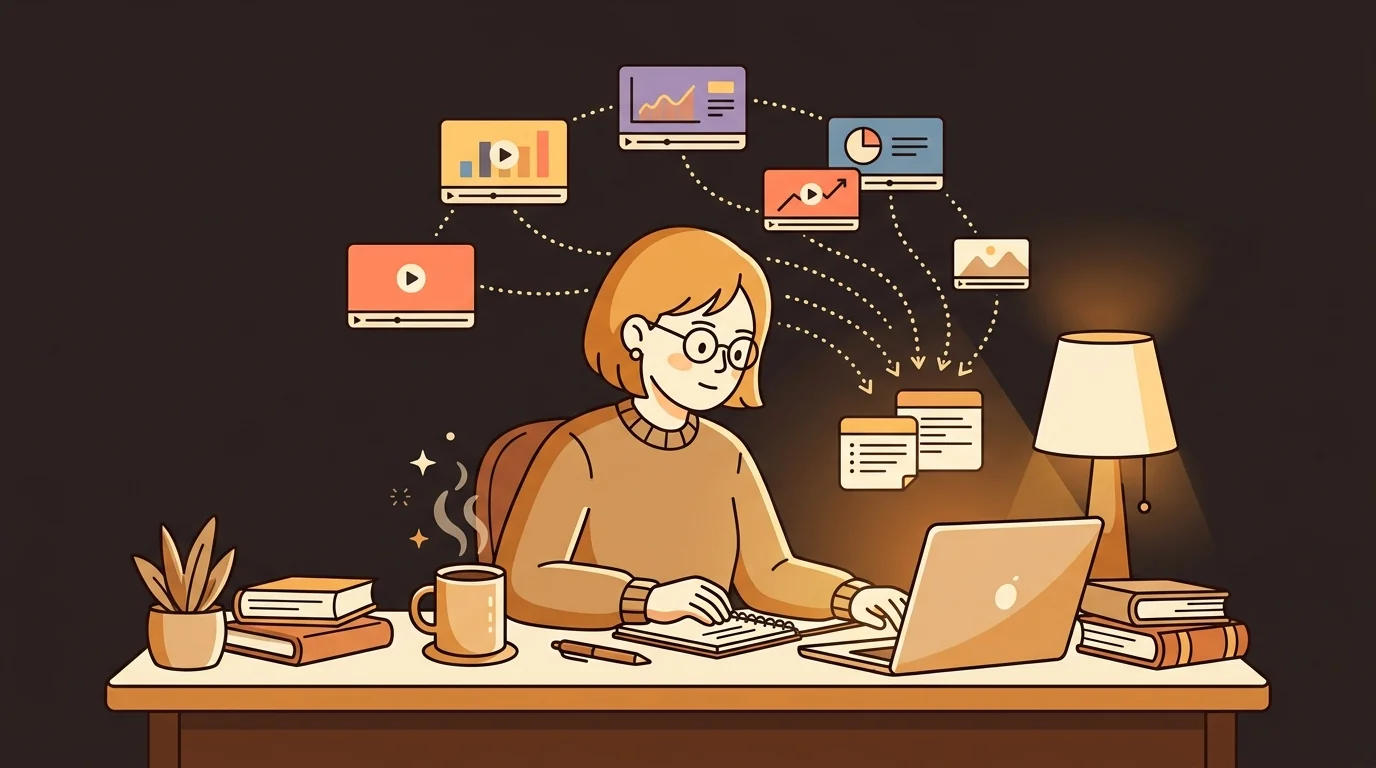
Transcripts arrive in time for my morning field notes session. I read the transcript from the previous day while writing my ethnographic field journal — the transcript refreshes detail I'd otherwise lose to the night's sleep.
Post-field processing: When I return home with 40+ hours of audio, the transcription is already half-done. My backlog is typically 8–10 hours of difficult audio (group conversations, noisy outdoor settings) that I've flagged for manual review.
Related: Transcribe Audio Recordings to Text: 5 Methods Tested and Ranked (2026)
Handling Multi-Language Recordings
My Yunnan fieldwork involved Mandarin, Southwestern Mandarin dialect, and occasionally Yi language fragments. No single transcription model handles this well out of the box.
My approach:
- Segment recordings at language-switch points using timestamps (I mark these in field during recording with a quiet audio cue — a pen tap on the recorder)
- Upload Mandarin segments with language set to "zh"
- Upload dialect-heavy segments with language set to "zh" but flag for heavier manual review
- Yi language fragments I transcribe manually — no commercial tool handles minority languages adequately
This segmented approach takes more upload time, but produces dramatically better Mandarin accuracy than treating the whole file as a single mixed-language upload.
[UNIQUE INSIGHT] The most useful feature of AI transcription for fieldwork isn't speed — it's searchability. After returning from Yunnan, I could search 40 hours of transcribed interviews for every instance an informant mentioned a specific farming practice or family name. Finding thematic patterns across dozens of informants — work that once required re-reading hundreds of pages of hand-typed transcripts — now takes minutes. This changes not just workflow but the kind of analysis that becomes feasible.
Data Ethics and Privacy
I treat informant recordings as sensitive data regardless of consent status. My protocol:
- Recordings stored locally on encrypted drives and in a password-protected cloud folder — not in general cloud storage
- Pseudonymized file names from day one; real names exist only in a separate encrypted key
- Cloud transcription only for recordings from informants who consented explicitly to digital processing
- Local Whisper transcription for sensitive sessions, interviews with vulnerable populations, or when data sovereignty of the community requires it
- Transcripts stored separately from the audio files with the same encryption standards
Before each field trip, I review the data governance requirements of my institution's IRB approval. The transcription workflow is part of the IRB application.
What Changed After Adopting This Workflow
The practical difference isn't just time. It's the kind of researcher I can be:
I can analyze while still in the field. With same-day transcripts, I can identify themes emerging across informants and adjust my interview focus before I leave. On my 2023 Yunnan trip, I noticed by week three that every informant over 60 used a specific term for a land tenure concept I hadn't flagged as central to the research. Because I could search my transcripts in the field, I spent weeks four through six probing that concept. I would have missed it entirely under my old workflow.
My field journal is richer. Writing field notes alongside a transcript rather than from memory alone produces more accurate, more detailed documentation.
The backlog anxiety is gone. The specific dread of returning from fieldwork to three months of transcription no longer exists. That freed cognitive space — small, but real — makes the fieldwork itself feel different.
For researchers still typing transcripts manually or paying per-minute human transcription rates on lengthy fieldwork audio: the math changes significantly at scale. See pricing for volume tiers that match long-form research workflows.
Frequently Asked Questions
Is AI transcription accurate enough for verbatim academic quotation?
For clean, single-speaker audio in a supported language, yes — at 3–5% WER, the error rate is comparable to human transcription under time pressure. For verbatim quotes in published research, I always verify the transcript passage against the source audio using the timestamp. I'd do the same with a human transcriptionist's output.
How do I handle recordings in languages with limited AI support?
Whisper supports 99 languages, but accuracy varies significantly. Major world languages (Mandarin, Spanish, French, Arabic) perform well. Regional dialects and minority languages typically require manual review or human transcription. Uploading a short test file in your target language before a field trip gives you a realistic accuracy baseline.
Can I transcribe long uninterrupted field recordings?
Yes — most AI tools handle files up to several hours. Longer files benefit from splitting at natural breaks (topic shifts, room changes) both for accuracy and for later searchability. A 3-hour monolith transcript is harder to navigate than three 60-minute thematic segments.
How should I handle group conversations with overlapping speech?
No tool handles overlapping speech accurately. My approach: mark heavily overlapping segments in the transcript with a flag, then listen to those passages specifically and correct speaker attribution manually. This takes 15–20 minutes per hour of group conversation, versus 3–4 hours to transcribe from scratch.
What microphone setup works best for field interviews?
A clip-on Lavalier mic on your primary informant, paired with your phone recording the room ambience as backup. If you're recording yourself as well, a dual-Lavalier setup significantly improves diarization accuracy. Directional mics work well for one-on-one formal interviews; omnidirectional mics are better for group discussions where you can't predict who will speak next.
The Research Calculus
Fieldwork produces data that's irreplaceable — you can't go back and re-ask a question from six months ago. The documentation workflow that converts that data into analyzable form is just as important as the fieldwork itself. When transcription is slow, you lose contextual recall. When it's fast and searchable, the analysis can begin while the experience is still fresh.
That's the practical argument for AI transcription in academic fieldwork. The efficiency numbers are compelling, but the real value is capturing the analysis you'd otherwise miss.
Start transcribing your field recordings free →

As a cultural anthropologist, I record everything in the field — informant interviews, group conversations, my own voice notes. AI transcription turned a two-week backlog into same-day searchable data.