I track consumer trends across seven markets: the US, UK, Germany, France, Japan, South Korea, and Brazil. Most of the useful market-specific data — the reports that actually capture what's happening on the ground — is published locally, in the local language. My German isn't functional. My Japanese is nonexistent. And until recently, that meant either skipping those sources or spending hours running documents through Google Translate and then trying to make sense of what came back.
The Language Gap in Market Research
If you work in a global market, you already know the problem. The most relevant data often isn't translated. A 60-page German consumer behavior report from a regional research firm. A Japanese industry white paper from a manufacturer's trade association. A Brazilian market sizing study in Portuguese. These exist. They contain real data. They're just not accessible without language fluency or a translation budget.
I used to have a two-step workaround: Google Translate the document, then skim the whole thing looking for the relevant sections. That process took 45–90 minutes per document. For the 10–15 reports I need to process in a typical week, that's most of my working hours — before I've done any actual analysis.
What Changed: Translation That Distills
A colleague suggested trying sipsip's Distill feature for the multilingual documents in our research pipeline. The workflow is simple: upload the document, select your output language, and receive the translated summary and key points in about 60 seconds.
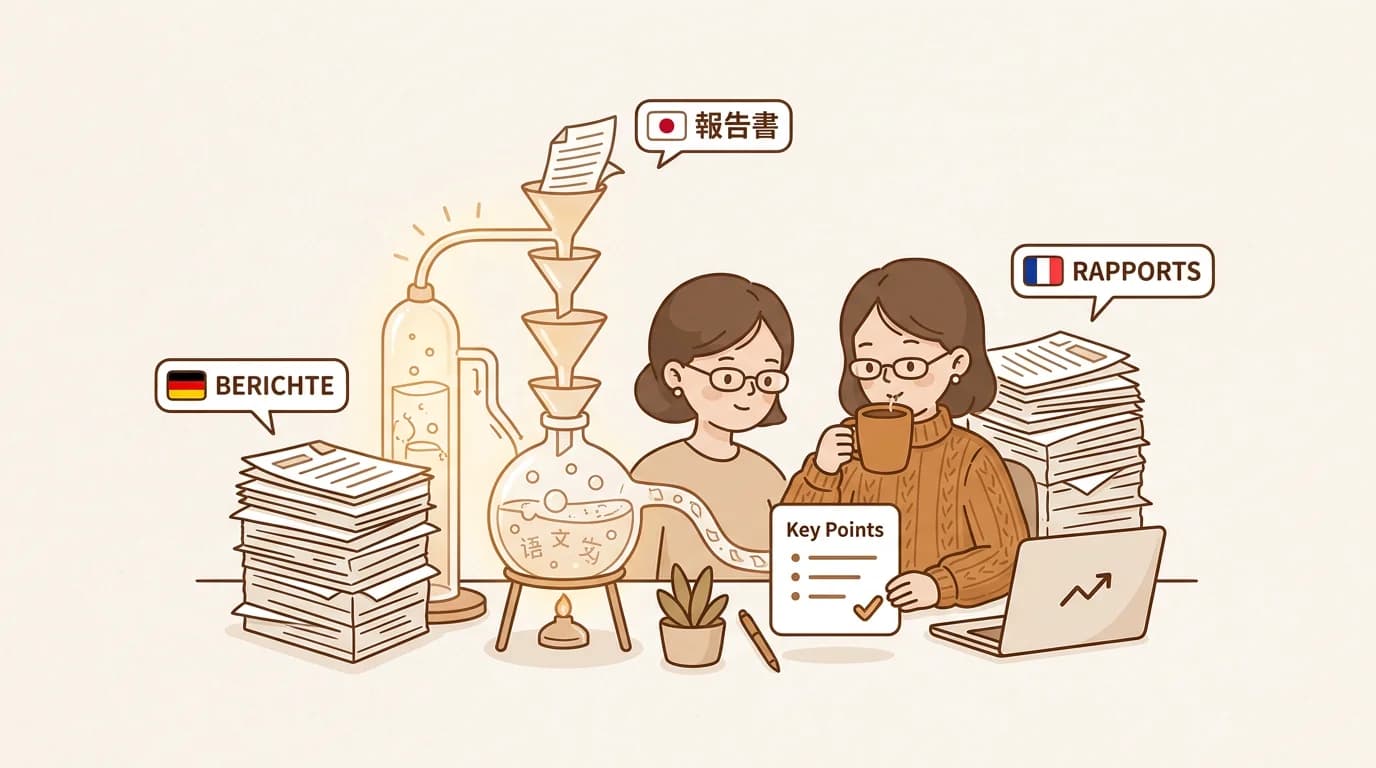
I was skeptical. I'd tried enough "AI research tools" that promised to solve this problem and delivered either garbage translation or useless summaries. What sipsip does differently is that it combines translation with actual content extraction — the output isn't just the full document run through a translation engine. It's the distilled content: what the report concludes, what the key data points are, what the main argument is.
For a 60-page German report on Q4 2025 retail consumer sentiment, the output was 8 translated key points and a 400-word English summary. I had the material I needed in 2 minutes instead of 90. When I needed to go deeper, the full context was there — but most of the time, the key points were enough.
My Weekly Workflow
Here's how I use sipsip for multilingual research now:
Morning triage (15 minutes): I queue up 5–8 documents from the previous day — reports flagged by our research tracking system, new white papers from partner organizations, government statistical releases. I upload them to sipsip with English set as the output language. By the time I've checked email, the translated key points are waiting.
Relevance screening: I scan the key points from each document to decide what deserves deeper attention. Maybe 2–3 documents out of 8 warrant more time. The rest I've sufficiently processed.
Deep reads: For the 2–3 that matter, I go back to the full translation (for YouTube and podcast URLs sipsip also provides complete translation, though for uploaded documents it's summary + key points). If I need verbatim sections for citations, I'll pull those from the original document using a separate translation check.
Cross-language synthesis: The real value compounds over time. When I have key points from a German report and a Japanese report on the same topic — both in English — I can compare them directly without language acting as a filter.
Languages I've Used This For
The 16 output languages sipsip supports cover every market I track:
- German (Germany market reports)
- French (France and Belgium consumer data)
- Japanese (Japan industry white papers)
- Korean (South Korea market research)
- Portuguese (Brazil market studies)
- Spanish (Latin America retail reports)
The translation quality is strong enough for professional use. I'm not submitting these translations for certified purposes — for that I'd still use a human translator. But for triage, synthesis, and understanding what a report concludes? The quality is more than sufficient.
What It Can't Do (And What I Still Do Manually)
sipsip is not a verbatim translation service. For uploaded files, you get summary and key points — not a word-for-word translated document. When I need a specific table, a specific statistic, or a quoted passage for a client report, I go back to the original document and translate that section specifically using DeepL or Google Translate.
I also don't use it for official documents. If we're filing regulatory submissions that require translated supporting documentation, those go to a certified translation agency.
What sipsip replaced is the time-consuming, low-value work of figuring out whether a document contains anything worth my attention — in a language I can't read.
The Time Math
Before sipsip: roughly 10 hours per week on multilingual document triage. After sipsip: roughly 2 hours per week on the same task, plus an hour of deeper dives.
That's 7 hours a week returned to actual analysis. Over a year, that compounds significantly.
If you work with sources in multiple languages — reports, academic papers, market data, news — try sipsip's free tier. Upload one report in a language you don't read. See what comes back in 60 seconds.
Sofia Andersson is a Market Research Analyst covering consumer trends across seven markets.

As a market research analyst, I spend hours every week reading reports that aren't in English. sipsip's translation + distillation feature cut that from hours to minutes.