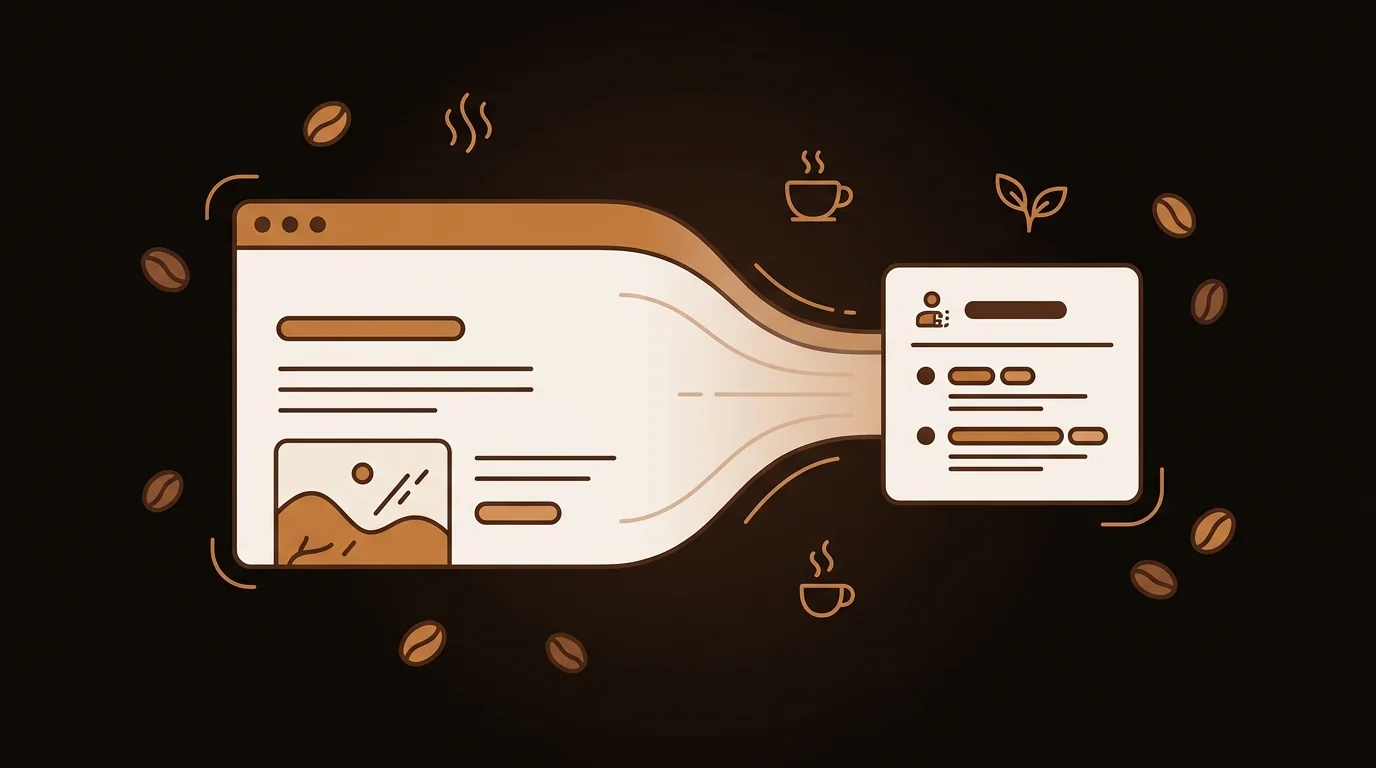
Reading everything on your reading list isn't possible. Skimming it all means missing what matters. AI web page summarization is the middle path — you stay current without spending hours on articles that turn out to be thin. Here are five methods that work right now.
Which Method Is Right for You?
| Method | Setup | Speed | Works on paywalled content? |
|---|---|---|---|
| Browser extension | One-time | 3 seconds | ❌ |
| Copy-paste into ChatGPT/Claude | None | 30 seconds | ✅ (if you can read it) |
| URL-based AI summarizer | None | 10 seconds | Sometimes |
| Daily Brief (automated) | 5 min | 0 (delivered to you) | Via subscription |
| Bookmarklet | One-time | 5 seconds | ✅ |
Method 1: Browser Extension (Best for Daily Browsing)
If you summarize web pages regularly, a browser extension is the most frictionless option. It adds a persistent summary panel to every page you visit.
Top picks in 2026:
- Sider (Chrome/Edge/Firefox) — AI sidebar with one-click page summary. Supports GPT-4o, Claude, and Gemini. Free tier includes 30 summaries/day.
- Monica (Chrome) — Summarize, chat with, and translate any page. Free tier available.
- Perplexity (Chrome) — Click the extension icon on any article for a sourced summary with citations.
How to use Sider:
- Install from the Chrome Web Store.
- Open any article.
- Click the Sider icon in the right sidebar → "Summarize page."
- A 5-bullet summary appears within seconds.
Limitation: Extensions can't access content inside login-required pages or apps.
Method 2: Copy-Paste into ChatGPT or Claude (Most Flexible)
This method works anywhere, including paywalled content, PDFs opened in a browser, and pages where extensions fail.
How to do it:
- Open the article. Select all text (Ctrl+A / Cmd+A), then copy (Ctrl+C).
- Open Claude.ai or ChatGPT.
- Paste the text and add this prompt:
"Summarize this article in 5 bullet points. Then give me the one most important idea I should remember."
Claude handles articles up to 200,000 tokens (roughly 150,000 words) on the free tier — more than enough for any article.
For very long research papers or multi-page reports: Use Claude 3.5 Sonnet or Gemini 1.5 Pro. Both handle book-length content without truncation.
Pro tip: Add your context to get more relevant summaries: "I'm a [job title]. What from this article is most relevant to [my industry/goal]?"
Method 3: Paste the URL into a Dedicated Summarizer
Some tools accept a URL directly and handle the fetching and summarization automatically.
sipsip.ai's Transcriber accepts any public URL — article, YouTube video, podcast, or PDF link — and returns a structured summary with key points and the full extracted text. Paste the URL, get results in under 15 seconds.
This is particularly useful when you're processing multiple sources in the same session (mixing articles, YouTube links, and PDFs) without switching between tools.
Tools that accept article URLs directly:
- sipsip.ai — articles, YouTube, podcasts, PDFs
- Perplexity AI — web articles with cited sources
- Kagi Summarizer — clean summaries, no account required for basic use
Note: Paywalled content and login-required pages usually can't be fetched by URL. Use Method 2 for those.
Method 4: Set Up a Daily Brief for Regular Reading (Best for Volume)
If you find yourself summarizing 5+ articles or videos per week, automating the process saves hours.
sipsip.ai's Daily Brief lets you subscribe to any YouTube channel, podcast, or website. Every morning, it sends you AI-generated summaries of new content from your list — delivered to email, Discord, or Telegram before you start your day.
Instead of opening 12 browser tabs at 8 AM and deciding what's worth reading, you get one digest with the substance of everything published, organized by source.
This is the difference between reactive summarization (summarizing things you've already found) and proactive summarization (receiving summaries of your curated sources automatically).
The setup takes about 5 minutes: add your sources, connect your delivery channel, and set your preferred time zone. After that, summaries arrive without any action on your part.
Method 5: A Bookmarklet for One-Click Summarization
A bookmarklet is a small JavaScript snippet saved as a browser bookmark. Clicking it opens a pre-filled prompt in your AI tool of choice with the current page's text.
How to create a Claude summarize bookmarklet:
- Copy the text of any article you want to summarize (Ctrl+A, Ctrl+C).
- Create a new bookmark in your browser.
- Set the URL to:
javascript:(function(){window.open('https://claude.ai/new?q=Summarize+this+article+in+5+bullet+points:+'+encodeURIComponent(document.body.innerText.substring(0,8000)))})();
- Name it "Summarize with Claude."
When you click the bookmark on any article page, it opens Claude with the first 8,000 characters of the page text pre-loaded in a summarize prompt.
Limitation: Bookmarklets truncate very long articles. For full accuracy on long-form content, Methods 2 or 3 are more reliable.
Choosing the Right Method for Your Workflow
| Use case | Recommended method |
|---|---|
| Occasional browsing | Browser extension (Method 1) |
| Paywalled or private content | Copy-paste into Claude (Method 2) |
| Mixed sources (YouTube + articles) | sipsip.ai URL summarizer (Method 3) |
| Following 10+ sources regularly | Daily Brief automation (Method 4) |
| No extensions allowed (work laptop) | Bookmarklet (Method 5) |
The common thread: AI summarization is most valuable when it becomes a habit rather than a one-time tool. The goal isn't to summarize one interesting article — it's to maintain awareness across your full reading list without the cognitive overhead of reading everything in full.
For a deeper look at how AI processes and summarizes long text, see how AI reads and summarizes web content and our guide to the best free article summarizer tools in 2026.
Related: Link to Text: How to Extract Readable Text from Any URL — sipsip.ai Transcriber: Any Source to AI Summary
Frequently asked questions

With a background spanning advertising and internet, I've launched 8+ apps and built 10+ products across mobile, web, and AI. Now I'm building a system that extracts signal from noise — turning fragmented information into clear, actionable decisions.