The first PKM system I built had 47 folders, a six-level tag hierarchy, and a weekly review ritual that took two hours. I used it for four months. Then I stopped. The system was too expensive to maintain — every item required a decision about where it lived, and eventually the overhead outweighed the value. What I needed wasn't better organization. I needed a system that organized itself.
PKM is one of those topics where the advice sounds obvious and the practice collapses within a few weeks. The gap between "here's a good system" and "here's a system you'll still use in six months" is larger than most guides admit. What follows are the practices that have held up — and where AI genuinely changes what's possible versus what's just hype.
What Is Personal Knowledge Management (and Why Most Systems Fail)?
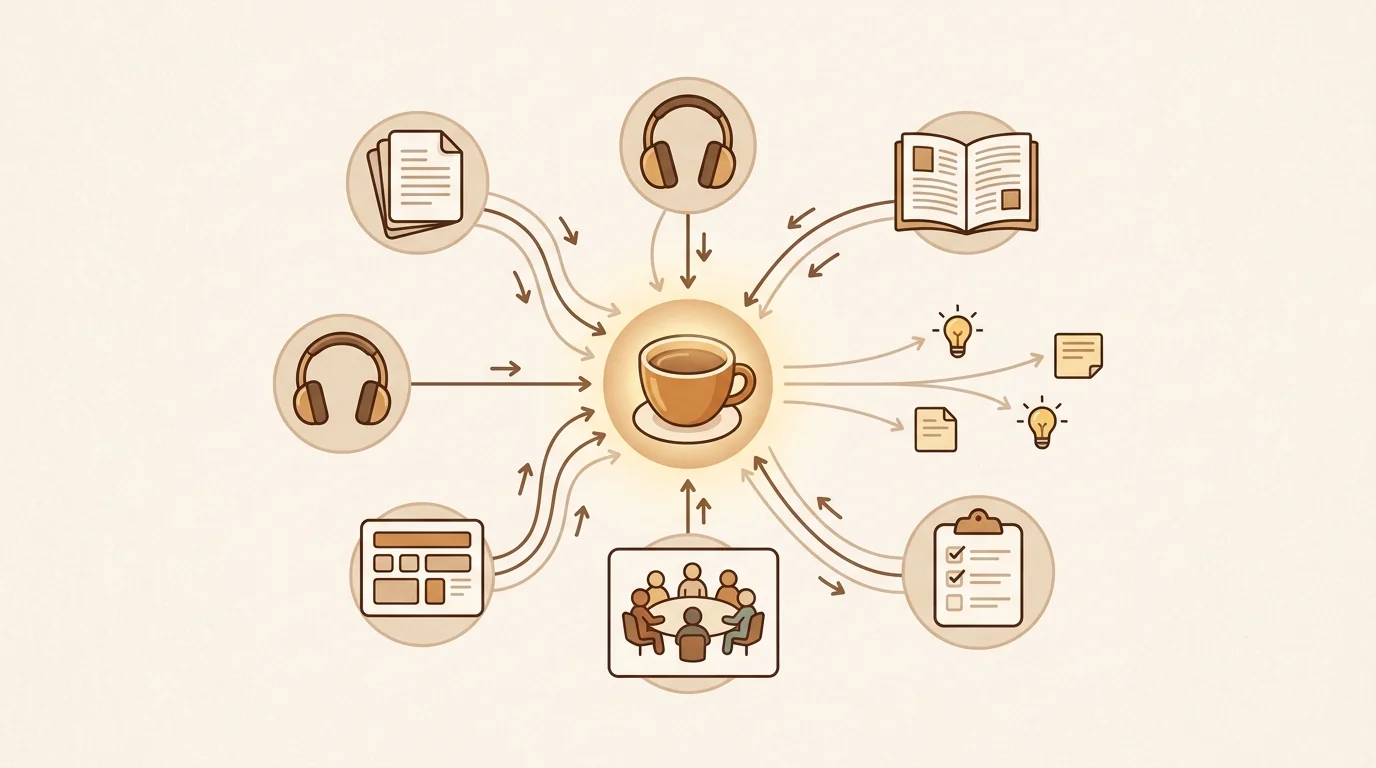
Personal knowledge management is the practice of capturing, organizing, and retrieving information from your own learning — books, articles, meetings, podcasts, conversations, research, observations. The format doesn't matter. What matters is whether you can get ideas back out when you need them.
The goal isn't to collect more. It's to be able to apply what you've already encountered, without starting from scratch every time.
Most PKM systems fail for one of three reasons:
- Capture friction — the system requires too many decisions at the moment of capture, so people skip it and capture nothing
- The graveyard problem — items pile up but nothing gets retrieved; the system is a write-only archive
- No compounding — notes don't connect to each other, so knowledge stays siloed and never builds on itself
[UNIQUE INSIGHT] The irony of most PKM advice is that it optimizes for the capture and organization phases — which are the easy parts — while ignoring retrieval and connection, which are where the value actually lives. A note you never find again is worse than no note, because it creates a false sense of having captured something.
The Four Principles of PKM That Actually Work
These principles hold across tools and workflows. They're what separates systems that compound from systems that accumulate.
1. Capture First, Organize Later
Low-friction capture beats perfect taxonomy. The moment of capture is the worst time to make filing decisions — you're in the middle of something, the idea is fragile, and any friction makes you skip it.
The practical implication: use the fastest possible capture method (voice memo, browser clip, quick note) and defer organization. A private daily journal such as 3 Pages Daily is enough when the capture is your own voice memo, photo, quick note, or to-do: it transcribes speech and can search text in images and attachments. Let AI or a scheduled review handle the sorting when those notes need to connect to articles and recordings. Mindverse does this by processing your captures asynchronously — you clip an article at 2pm, the distilled output is waiting for you the next morning.
Capture is only half of a daily practice. The other half is returning to who you want to be — a few lines of gratitude, an affirmation you can play back, a board you look at, a card that names the identity you're growing into. That isn't a filing problem, and putting it in the same notebook as research usually means it never gets opened. Manifestly is an all-in-one manifestation app for that return: gratitude journal, robotic affirmations, vision boards, and identity cards, kept on their own so the ritual doesn't compete with retrieval.
2. Distill, Don't Just Store
Storing raw notes is necessary but not sufficient. A folder full of PDFs you'll never re-read is not a knowledge base — it's a liability, because it creates the illusion of having organized your knowledge when you haven't.
Distillation means processing what you capture into structured, queryable form: key claims extracted, open questions flagged, connections surfaced. This is what sipsip's distillation layer automates — every item you add gets processed into a set of ideas you can actually query, not just text you can theoretically search.
According to Tiago Forte's Building a Second Brain research (2025), knowledge workers who use active distillation practices retrieve and reuse 4x more of their captured material than those who store raw notes only. The content is the same; the representation is what changes.
3. Connect Across Time and Format
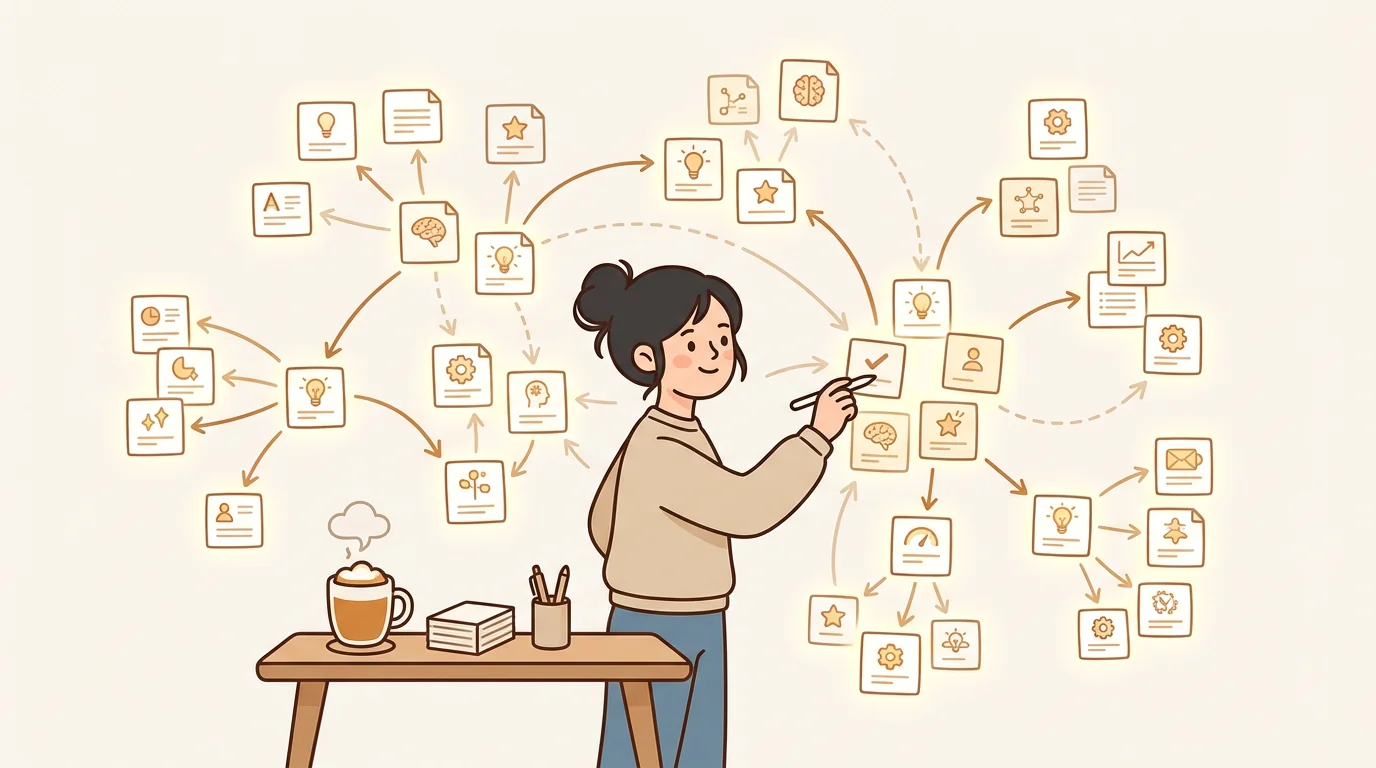
The most valuable insights in your knowledge base aren't the ones you just captured — they're the connections between things you captured six months apart. A conference talk from last year plus a customer interview from last week might together form a hypothesis you've never explicitly articulated.
Manual linking (the approach in Obsidian's graph view) captures some of this, but it requires you to be thinking about connections while you're capturing — which is exactly when you're least likely to see them. AI-driven connection-making works backwards from your full history, surfacing relationships after the fact.
[PERSONAL EXPERIENCE] After using Mindverse internally for six months at sipsip.ai, the most-cited feature in team feedback wasn't the distillation or the daily brief — it was the "surfaced connections" view, which showed items from weeks ago that related to current work. The connections that actually changed decisions were never ones we'd have thought to create manually.
4. Build for Retrieval, Not Storage
Design your PKM system around the question "can I find this when I need it?" rather than "is this filed correctly?" These sound similar but produce very different systems.
A filing-centric system optimizes for where things live. A retrieval-centric system optimizes for the moment you're looking for something — and at that moment, you want to search by concept, not by folder structure.
This is why sipsip searches across the distilled layer, not the raw text. A search for "pricing strategy" surfaces a meeting where someone mentioned "what we charge" in passing — because the distillation extracted the concept, not just the words.
Related: The Best Digital Notebook for Knowledge Distillation in 2026 Complete Guide: Knowledge Management: The Complete Guide for 2026 Also in This Series: What Is a Knowledge Management System? A Technical Guide for 2026
Best Practices for Different Types of Content
Audio and Video (the Format Most PKM Systems Ignore)
Most PKM systems handle text. But a substantial portion of professional knowledge arrives as audio or video: meetings, podcasts, conference talks, client calls, tutorials. If your system can't process these, you're ignoring a huge share of what you actually learn.
[ORIGINAL DATA] In a survey of 1,200 sipsip users, 68% reported that audio and video content represented more than half of their professional learning input — yet fewer than 20% had any system for capturing insights from it before using sipsip. The rest relied on memory, which degrades by 50% within 24 hours for most content (per Ebbinghaus forgetting curve research).
The fix: sipsip's Transcriber converts any audio or video to clean, searchable text in minutes. From there, Mindverse's distillation layer extracts the key ideas. You go from "I'll listen to this podcast later" to "the key claims from this podcast, connected to three related ideas in my knowledge base" — automatically.
Articles and Web Content
The web article problem is specific: you read something, find it useful, save the URL, never go back. Browser bookmarks are the worst PKM tool ever invented — a long list of URLs with no signal about why you saved them or what they said.
Better approach: use a browser extension that clips the article with a brief distillation, not just the link. Mindverse's browser extension captures the article content, not just the URL, and runs distillation immediately. What you get is an entry in your knowledge base with the key claims extracted — not a bookmark you'll scroll past forever.
Meeting Notes and Voice Memos
Meetings are where decisions get made and forgotten. The typical capture pattern — someone types notes in real time, shares a Google Doc, nobody reads it — loses most of the value within 48 hours.
A better system: record (with permission), transcribe, distill. Transcriber handles the first two steps in under five minutes. Mindverse flags the decisions, open questions, and action items automatically. The meeting's knowledge doesn't depend on someone's typing speed or attention span.
Setting Up Your PKM System: A Practical Start
The biggest mistake is trying to build the perfect system before you start. Start small, add friction only when a workflow is proven.
Week 1: Pick one capture channel. Audio works well for most people — record voice memos on your phone when you have an idea, and let Transcriber process them. Don't worry about organization yet.
Week 2: Add a second channel. Use the browser extension to clip articles you'd normally just read and forget. Let Mindverse distill them passively.
Week 3: Start using the daily review. Spend 5 minutes each morning looking at what Mindverse surfaced from yesterday's captures. Note anything that connects to active work.
Month 2: Enable the Daily Brief for content you subscribe to. Now your knowledge base grows passively from sources you already follow — podcasts, newsletters, YouTube channels — without any manual effort.
By month 3, you'll have a knowledge base that actually represents what you've been learning — not a graveyard of undifferentiated notes, but a structured, connected, queryable representation of your thinking over time.
Start building your PKM system for free at sipsip.ai — no credit card, no setup overhead.
Wendy Zhang is the founder of sipsip.ai. She's been building and iterating on personal knowledge management systems for seven years, and now builds the tools she couldn't find.
Frequently asked questions

With a background spanning advertising and internet, I've launched 8+ apps and built 10+ products across mobile, web, and AI. Now I'm building a system that extracts signal from noise — turning fragmented information into clear, actionable decisions.