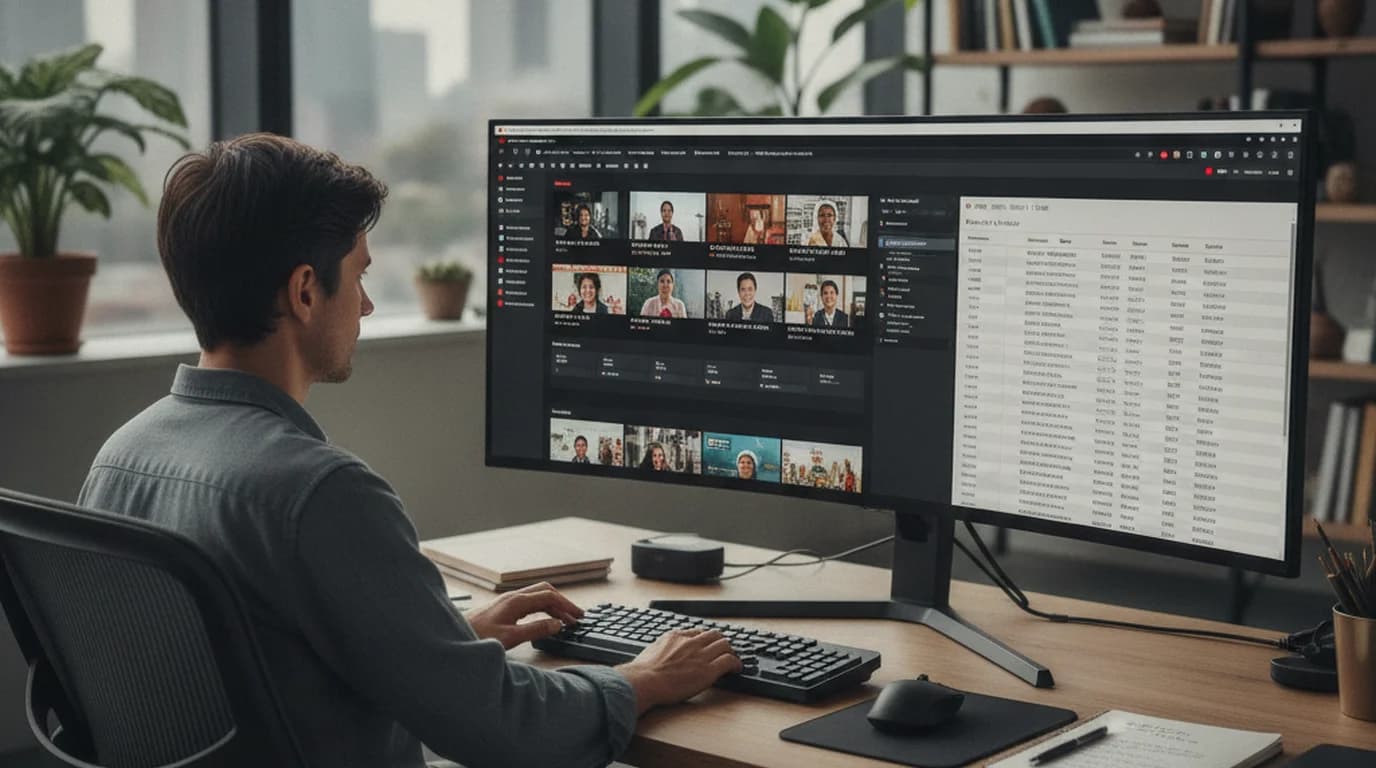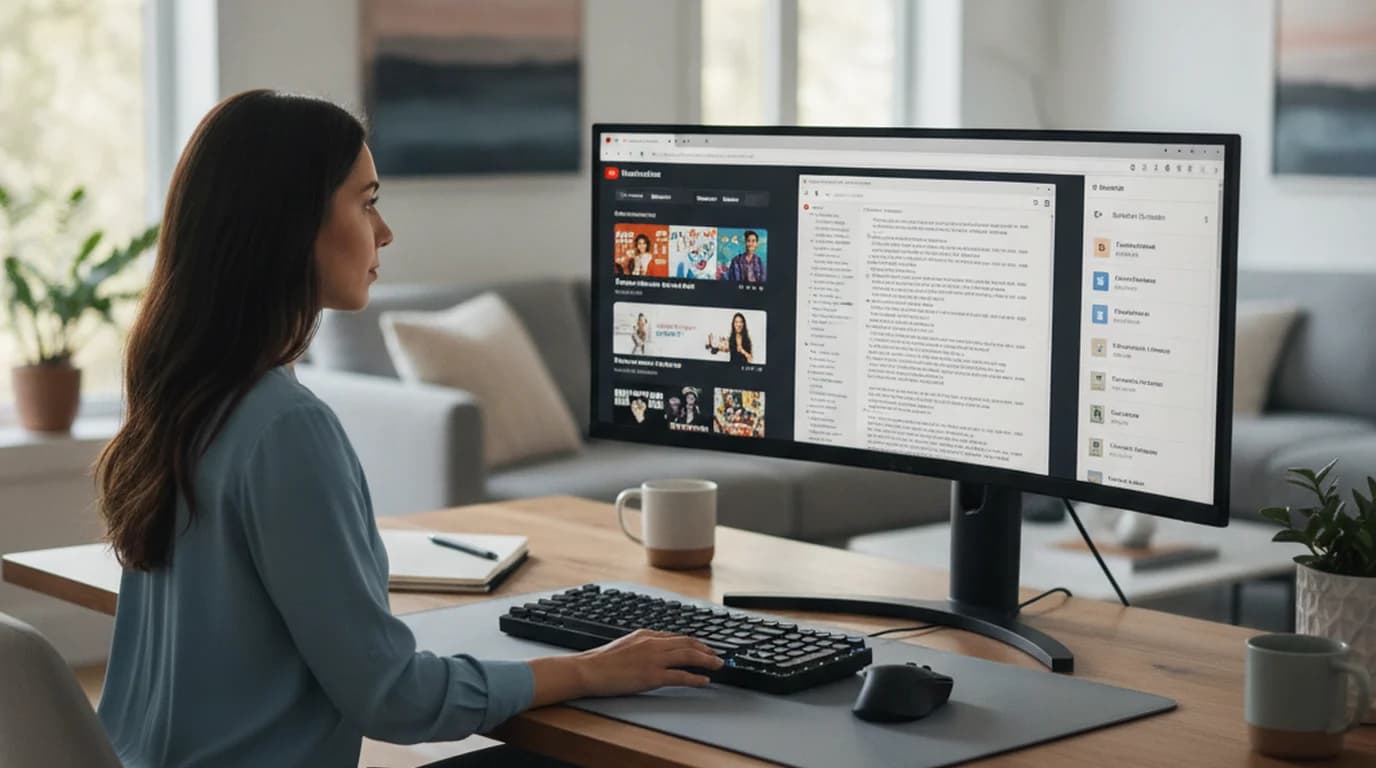
My job is to understand what creators are saying, how audiences are engaging, and what narratives are gaining traction across YouTube categories. For any meaningful research, that means working with dozens of channels simultaneously — watching key videos, identifying patterns across content, tracking how a creator's messaging evolves over time.
The part nobody mentions: 50 channels publishing 2–3 videos per week generates more content than anyone can actually watch.
The Watching Problem
Research methods that depend on watching content hit a ceiling fast. A 20-minute video takes 20 minutes to watch at 1x speed, 13 minutes at 1.5x, and still requires active attention and manual note-taking throughout. Across 50 channels, even watching 20% of published content would consume 30+ hours per week — not counting the synthesis and reporting.
I needed a method that didn't require watching.
Transcripts as the Research Object
The shift that changed my workflow: treating the transcript as the primary research object, not the video.
A transcript is searchable. I can find every instance of a specific term, phrase, or topic across 50 channels in seconds. I can extract direct quotes with exact timestamps for citation. I can compare how different creators describe the same event or product. I can track when specific language patterns appear and which channels adopt them first.
None of this is feasible when the research object is video.
My Workflow for YouTube Content
For a new video from a channel I'm monitoring:
I paste the YouTube URL into sipsip.ai's transcriber. I don't download the video — I don't need the video file. What I need is the text. Processing takes 3–5 minutes for a typical 20–30 minute video.
The output I get:
- Full transcript with timestamps
- AI summary (the 3–5 main points the creator covered)
- Key moments flagged by the model
The summary tells me immediately whether this video warrants closer reading. If the summary identifies topics I'm tracking, I read the full transcript. If not, I file the summary and move on.
"I can scan 10 new videos across different channels in the time it used to take me to watch one."
— Jiwon Kim
Related Article
YouTube to Text: How to Get a Text Transcript from Any Video
When I Actually Need the Video File
For archival purposes — when I need to store a copy of content that may be taken down, or when a client needs the video itself — I use yt-dlp to download the MP4:
yt-dlp -f "bestvideo[ext=mp4]+bestaudio[ext=m4a]/mp4" [URL]
This downloads the highest-quality MP4 with audio. I use this for:
- Videos from accounts that frequently delete content
- Client deliverables that require the actual video file
- Research where visual analysis (not just audio) matters — camera work, graphics, editing style
For the majority of content analysis work, I don't need the file. The transcript serves the research purpose.
Building a Research Archive
I maintain a structured folder system by channel name and date. Each video gets a folder containing:
- The transcript text file (exported from sipsip.ai)
- The AI summary
- My research notes
After 6 months of tracking a channel, I have a complete text archive of its output. Searching this archive across months of content — to see when a creator first discussed a topic, or how their language around a product changed — takes seconds.
Related Article
How to Get a YouTube Transcript (3 Free Methods for 2026)
Korean YouTube Content
A significant portion of the channels I track publish in Korean. Sipsip.ai handles Korean natively — I select Korean as the source language, get the Korean transcript, and translate with Papago or DeepL.
Korean YouTube in particular has extensive closed caption coverage on larger channels. When sipsip.ai retrieves existing captions rather than transcribing fresh audio, the accuracy is noticeably cleaner — YouTube's Korean ASR is well-calibrated.
For multi-language channel analysis (creators who publish in Korean with English subtitles, or vice versa), I process the primary language audio and use the transcript as the source.
Jiwon Kim is a YouTube content researcher who tracks creator and platform trends across English and Korean YouTube. She uses sipsip.ai to build searchable transcript archives from channel content for systematic research and reporting.
Frequently asked questions

As a YouTube content researcher, I need to capture, archive, and analyze video content from dozens of channels simultaneously. Getting the content into a format I can actually work with — searchable, quotable, referenced by timestamp — is the whole job.